Resolving Late-Summer Airflow Drops in Camas Two-Story Homes
The Frustration of an August Heatwave in Your Upstairs Bedrooms
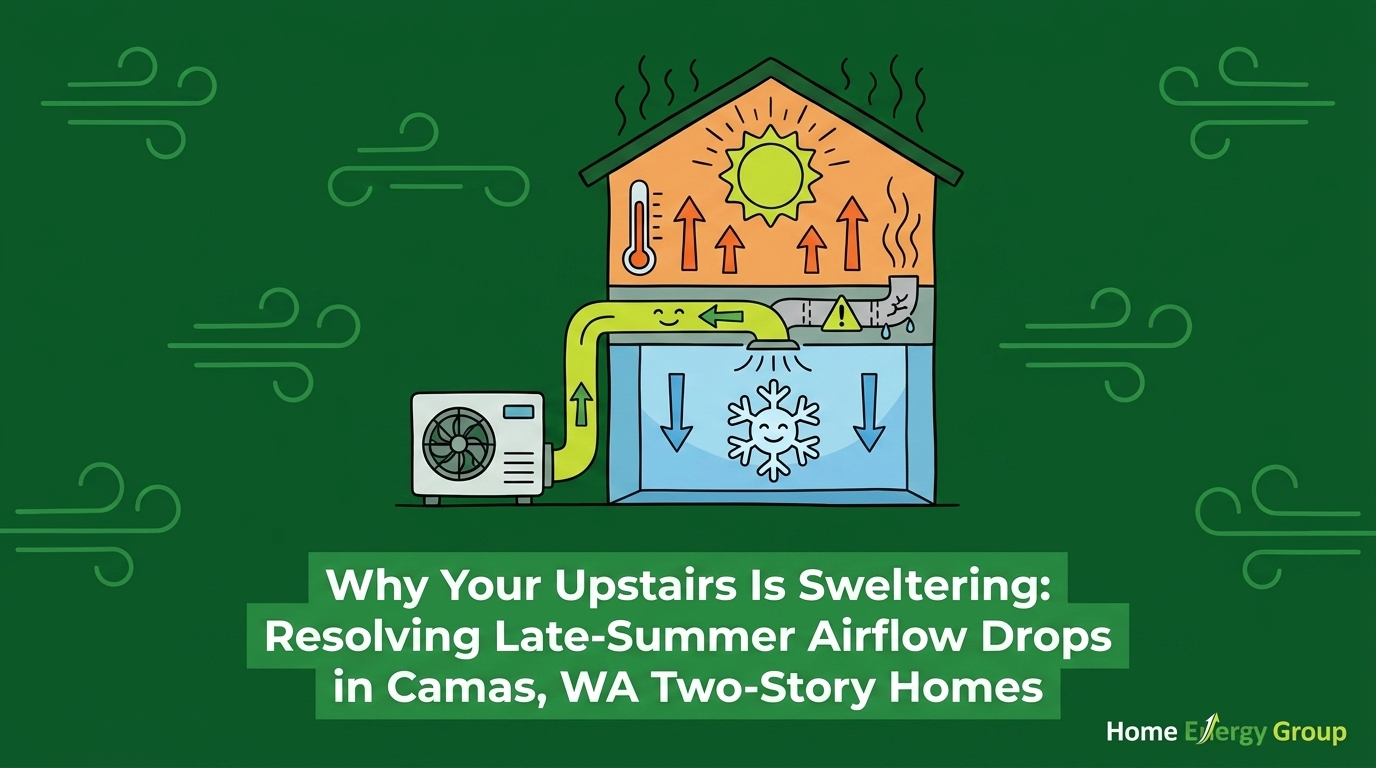
Your AC is running nonstop, but the upstairs bedrooms still feel like a sauna while the downstairs living room is freezing. Resolving late-summer airflow drops in Camas two-story homes requires more than just lowering the thermostat; it demands an understanding of the unique physics and seasonal strain affecting your HVAC system. At Home Energy Group, we understand the specific frustration of trying to sleep in a sweltering second-floor room—it is a struggle our technicians see daily as local homeowners battle the peak of the cooling season. The intense, extended August heat in the Pacific Northwest maximizes system strain, turning minor duct imbalances into severe comfort issues.
The good news is that these late-summer airflow drops are rarely a sudden, catastrophic mechanical failure. Instead, a pattern we see often is a cumulative issue that builds up over months of continuous operation. The core culprits our team typically finds revolve around two main factors: accumulated filter load restricting your blower motor, and misadjusted seasonal duct dampers that fail to direct cold air where it is needed most. By understanding these components, you can learn what to safely check yourself and what requires our professional diagnostics.
If you are tired of battling uneven temperatures, reaching out for professional air conditioning services is the most reliable way to evaluate your system's performance and restore whole-home comfort.
Understanding Thermal Stratification in Two-Story Architecture
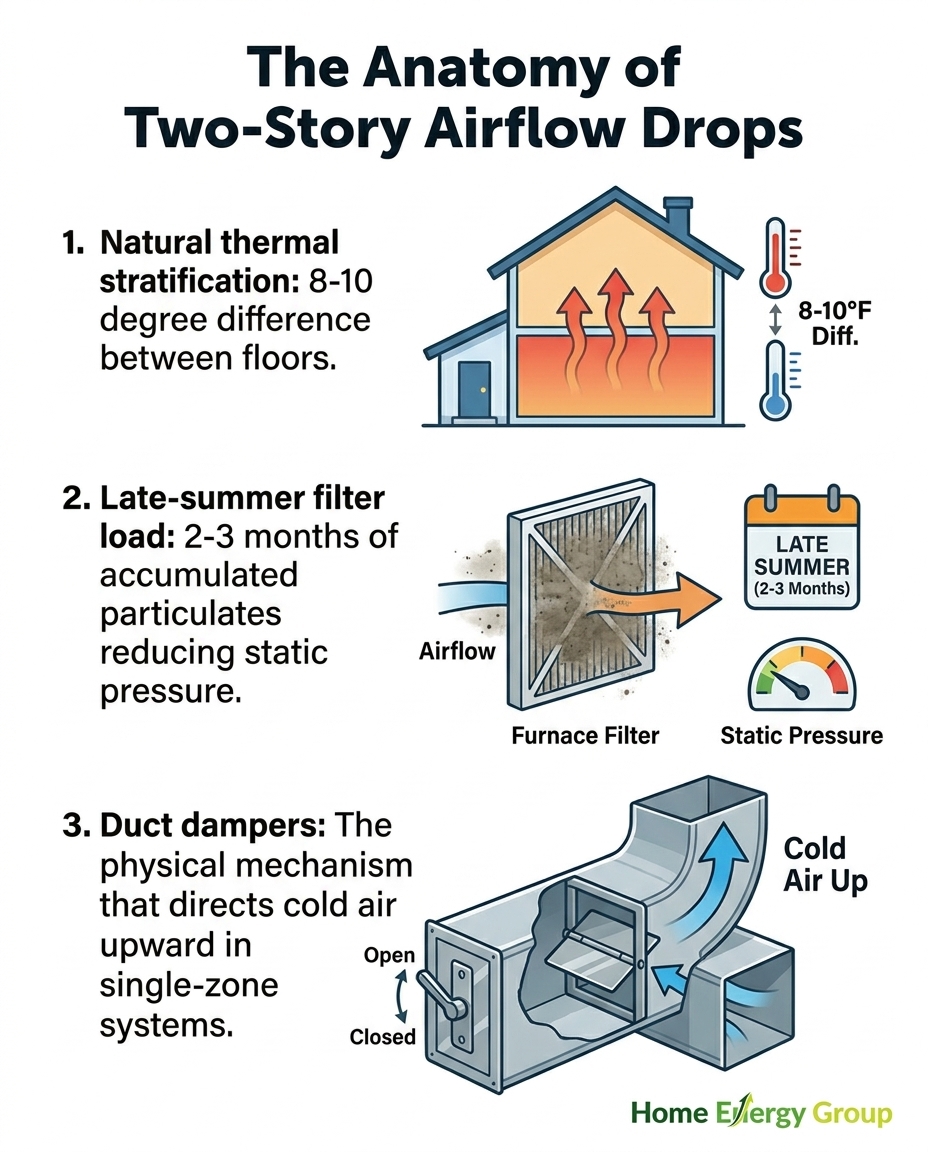
To fix an unevenly cooled home, you first have to understand the basic physics working against your HVAC system. Natural thermal stratification is the scientific term for the simple fact that heat rises. In the hundreds of Camas two-story homes our team has serviced, we frequently observe this natural convection process causing the warmest air in the house to accumulate on the second floor. Without proper airflow balancing, this can easily result in an 8 to 10-degree temperature difference between the main floor and the upstairs bedrooms.
Compounding this issue is the layout of your ductwork. The furthest vents from the indoor blower motor are typically located in the upstairs bedrooms. When total system airflow drops for any reason, these distant vents are always the first to suffer. Cold air is dense and heavy, meaning the blower motor has to work incredibly hard to push it upward against gravity. When airflow is restricted, the heavy cold air simply spills out of the closest downstairs vents, leaving the upstairs starved for cooling. Running the AC longer does not solve the physics of poor air distribution; it only drives up your energy usage while overcooling the ground floor.
The Limits of Single-Zone Cooling
Our installers at Home Energy Group often find that many local two-story builds rely entirely on single-zone cooling systems, meaning one thermostat controls the temperature for the entire house. Single-zone systems struggle to push heavy, cold air upward without proper balancing because they cannot direct airflow to specific areas based on need. The thermostat, usually located downstairs, registers that the target temperature has been reached and shuts the system off long before the upstairs has had a chance to cool down.
• First Floor (Main Living Area) — Airflow Dynamics: Receives the bulk of heavy, dense cold air immediately from the blower. — Cooling Challenge: Often overcooled, leading to freezing temperatures while the AC tries to cool the rest of the house.
• Second Floor (Bedrooms) — Airflow Dynamics: Furthest from the blower motor; requires high static pressure to push air against gravity. — Cooling Challenge: Suffers from thermal stratification (heat rising) and weak airflow from distant vents.
The Cumulative Impact of Late-Summer Filter Load
By the time August late-summer heatwaves arrive, your HVAC system has likely been running consistently for several months. During this time, the air filter has been working silently to trap dust, pet dander, pollen, and other airborne particulates. In the Pacific Northwest, the accumulation of summer wildfire smoke particulates from June and July acts as a major contributor to late-summer filter clogging. A pattern we see often on service calls is that what started as a clean, highly breathable filter in May is heavily loaded with debris by the back-to-school transition in August.
A heavily loaded air filter significantly increases the static pressure within your forced-air system. The blower motor has to pull air through that filter before it can push it through the ductwork. When the filter is choked with debris, the motor cannot intake enough air, which directly translates to reduced total system airflow output. As we established earlier, the upstairs vents are the furthest away and the most vulnerable to airflow drops. Therefore, our technicians frequently diagnose a dirty filter as the root cause of a sudden lack of cooling in second-story bedrooms.
For some homeowners, the limitations of central ductwork and constant airflow battles become too frustrating. One local homeowner facing similar struggles decided to bypass their central ductwork entirely; they requested a ductless heat pump system from us, which was quoted and installed in a couple of hours, resulting in extreme satisfaction and targeted upstairs cooling. However, if you are sticking with your central system, you must understand what happens to your system when the AC runs all day against a clogged filter—it leads to frozen evaporator coils, overheated blower motors, and excessive end-of-season wear and tear.
The Role of Seasonal HVAC Dampers in Forced-Air Systems
If your filter is clean but your Camas two-story homes are still suffering from uneven cooling, our team typically finds that the next culprit is the seasonal HVAC dampers. Dampers are physical valves or plates located inside your ductwork that control the volume of air flowing to different zones of the house. In a single-zone system, these manual dampers are the only way to balance the airflow between the first and second floors.
Because heat rises and cold air sinks, your ductwork requires different balancing for summer cooling than it does for winter heating. In the winter, you want to push more warm air downstairs, allowing it to naturally rise. In the summer, you must manually adjust these dampers to force the heavy, cold air upstairs, allowing it to naturally cascade down to the first floor. If your dampers are still left in their winter heating settings, your system will actively starve the upstairs of necessary cooling, dumping all the conditioned air into the already-freezing living room.
Identifying Your System's Dampers
Locating and understanding your system's dampers is a crucial part of managing forced air systems. They are typically located on the main supply trunks branching off from the indoor air handler or furnace, often visible in basements, crawlspaces, or utility closets.
• Physical appearance: Look for small metal levers or wingnuts on the outside of the exposed sheet metal ductwork.
• Airflow markings: The position of the lever indicates the position of the damper plate inside. When the lever is parallel to the duct, the damper is fully open. When it is perpendicular, the damper is closed, blocking airflow.
• Seasonal adjustments: We recommend you partially close the damper feeding the downstairs trunk and fully open the damper feeding the upstairs trunk during the summer months.
Safe Homeowner Troubleshooting Steps for Restricted Airflow
When an August late-summer heatwave strikes and your upstairs airflow drops, Home Energy Group recommends several safe, non-technical steps you can take to troubleshoot the issue before scheduling a service call. It is vital to observe strict boundaries: never attempt to dismantle ductwork, adjust internal blower motor speeds, or check refrigerant levels yourself, as these tasks require a licensed professional.
1. Check and replace the air filter immediately: Pull out your current HVAC filter. If it is gray, opaque, or heavily coated with dust and pet hair, replace it immediately with a fresh, clean filter of the correct size.
2. Ensure all return vents are completely unblocked: Walk through your home, especially the upstairs bedrooms and hallways, and verify that no return air grilles are blocked by furniture, heavy rugs, or curtains. The system needs to pull hot air out of the upstairs just as much as it needs to push cold air in.
3. Verify that accessible supply registers are open: Check the supply vents in the upstairs bedrooms to ensure the louvers are fully open. Conversely, you can partially close a few supply vents on the main floor to help force more air upward, though you should never close more than 20% of your home's total vents to avoid static pressure issues.
4. Inspect accessible manual dampers: If your ductwork is exposed in a utility room, check the damper levers to ensure the trunk line feeding the second floor is in the fully open (parallel) position.
When to Call a Clark County HVAC Professional for Complex Duct Issues
If you have replaced your filter, opened your registers, and checked your accessible dampers, but your Camas two-story homes are still sweltering upstairs, it is time to call in the experts at Home Energy Group. Certain signs indicate that the issue has progressed beyond safe DIY troubleshooting. If you feel warm air blowing from your vents while the AC is running, hear strange grinding or whining noises from the blower motor, or notice ice forming on the indoor evaporator coil or outdoor refrigerant lines, shut the system off immediately.
Our professionals have the tools and training to measure static pressure directly within the ductwork, allowing us to evaluate blower performance and diagnose hidden blockages, crushed ducts, or severe air leaks that are bleeding your cold air into the attic. Forcing the system to run constantly when airflow is severely restricted will only lead to premature compressor failure or a burned-out blower motor.
Property managers and landlords see this frequently. During a recent period of sweltering heat, the manager of several local rental homes experienced widespread HVAC system issues causing tenant discomfort. Our Home Energy Group dispatchers contacted the tenants immediately, guided them through safe phone checks, and sent technicians within an hour when those basic checks didn't resolve the issue, ensuring comfort was restored quickly. We bring deep local experience in Brush Prairie and the greater Clark County area, expertly diagnosing complex forced-air and duct damper issues that generic technicians might overlook. If your home's architecture simply won't allow for adequate upstairs cooling, our team can evaluate your layout for custom duct design and modification.
Proactive Solutions to Prevent Future Airflow Drops
Instead of waiting for an August late-summer breakdown, implementing proactive solutions can ensure consistent cooling throughout the entire season. The most effective long-term strategy we recommend is committing to routine seasonal maintenance. A comprehensive tune-up allows our technicians to catch static pressure issues early, clean the blower wheel, and verify that your system is moving the correct volume of air before the peak heat arrives.
You should also establish a strict filter replacement schedule during the peak summer months. While a high-capacity filter might last longer in the mild spring, the heavy usage of summer—combined with local environmental factors like pollen and wildfire smoke—often necessitates replacing the filter every 30 to 45 days. For homes where manual dampers and clean filters still aren't enough, consider long-term upgrades. Implementing automated zoning controls or modifying your ductwork can permanently solve thermal stratification issues.
Staying ahead of these problems is easy when you enroll in a routine HVAC maintenance plan, which ensures your system is professionally balanced and inspected by our team year after year.
Frequently Asked Questions About Upstairs Cooling Issues
Why does my AC struggle to cool the second floor in late summer?
Your AC struggles to cool the second floor in late summer primarily due to accumulated filter load and natural thermal stratification. By August, your air filter has likely trapped months of dust and particulates, increasing static pressure and reducing the blower motor's ability to push heavy cold air up to the furthest vents. Additionally, the prolonged heat bakes the roof and attic, increasing the heat load on the upper floor.
Why is my AC running but the upstairs is hot?
If your AC is running but the upstairs is hot, our technicians usually find the system is suffering from restricted airflow or misadjusted duct dampers. Cold air is heavy and naturally wants to fall to the lowest point in the house. If the airflow is weak due to a dirty filter, or if the seasonal dampers are still set for winter heating, the cold air will simply dump out of the downstairs vents, leaving the upstairs starved.
How do I balance the airflow in a two-story house?
Balancing airflow in a two-story house involves directing more conditioned air to the areas that need it most. You can achieve this by locating the manual duct dampers on your main supply trunks and adjusting them to push more air upstairs during the summer. You can also partially close a few downstairs supply registers, though we advise you never close too many, as this can cause harmful static pressure buildup.
Should I adjust my HVAC dampers for summer?
Yes, you should absolutely adjust your HVAC dampers for the summer cooling season. Because heat rises and cold air sinks, your ductwork requires different balancing for summer than it does for winter. You need to open the dampers feeding the upstairs trunk lines and partially close the dampers feeding the downstairs to force the heavy cold air up to the second floor.
How often should I change my AC filter in summer?
During the peak summer months, we recommend checking your AC filter every 30 days and expect to change it every 30 to 45 days. High system usage, combined with summer dust, pollen, and regional wildfire smoke, causes filters to clog much faster than they do in the milder spring or fall seasons. A clean filter is the single most important factor in maintaining strong upstairs airflow.
Can a clogged air filter cause my AC to stop blowing cold air upstairs?
Yes, a clogged air filter is one of the most common reasons an AC stops blowing cold air upstairs. A dirty filter chokes the intake of the blower motor, drastically reducing the total volume of air the system can move. Because the upstairs vents are the furthest away and require the most pressure to reach, they are always the first to lose airflow when the filter becomes restricted.
Restore Your Home's Comfort Before the Season Ends
Uneven cooling and sweltering upstairs bedrooms are solvable problems, not something you have to endure just because it is an August late-summer heatwave. While checking your filters and unblocking vents are great first steps, complex duct issues and persistent thermal stratification require local expertise to resolve safely. Do not let your system run constantly while failing to keep you comfortable. Encourage a balanced, efficient home by scheduling a professional inspection with Home Energy Group to optimize your airflow and restore total comfort before the back-to-school season ends.