
AC Repair Near Me: Troubleshooting Constant Cooling Cycles and Frozen Coils
Why Your AC Won't Stop Running During a Heatwave
When your cooling system is running nonstop but the house still feels warm, you might be wishing you had completed a thorough seasonal home maintenance checklist before the extreme summer weather arrived. During a sudden Pacific Northwest heatwave, our team at Home Energy Group fields countless calls from stressed homeowners listening to their air conditioners work overtime while the indoor thermostat temperature continues to climb. You might immediately assume the worst—that the compressor has failed, a major mechanical component is broken, or you are facing a complete system replacement.
However, continuous system operation during extreme heat does not automatically mean the equipment is malfunctioning. The most critical step right now is determining whether your system is simply maxed out by the extreme outdoor temperatures or if there is a genuine mechanical failure. Understanding your cooling system's baseline expectations can save you from unnecessary panic, a pattern we see often when helping local families decide the right path forward for restoring their home's comfort safely.
For comprehensive support and guidance regarding your home's cooling system, explore our HVAC services.
The Reality of Extreme Heat on Cooling Equipment
Here in Brush Prairie, the July peak summer months put your air conditioning system under immense stress. Air conditioners and heat pumps are designed to move heat from inside your home to the outside. When the outdoor temperature spikes dramatically, the amount of heat energy penetrating your home's walls, roof, and windows increases exponentially. This is known as the thermal load. If the thermal load entering the house equals the amount of heat the air conditioner can remove, the system will run continuously just to maintain a baseline temperature.
The key takeaway: A system that runs continuously without cooling the house down further is not necessarily broken. It may simply be working exactly as hard as it was engineered to work. Before you panic and assume you need immediate emergency repairs, it helps to understand the technical limits of residential cooling design.
The 20-Degree Rule: Understanding Thermal Load Limits
Standard residential cooling systems are engineered with specific mathematical limits in mind. Across the HVAC industry, air conditioners and heat pumps are typically designed to maintain a 20-degree temperature differential from the outside air. This means that on a mildly hot day, your system can easily keep your home crisp and cool. But when extreme weather hits, those design limits become very apparent. Our technicians constantly remind customers that air conditioners are bound by these thermal dynamics.
How the Temperature Differential Works
If the temperature outside in Brush Prairie WA reaches a blistering 100 degrees, a perfectly functioning, well-maintained air conditioner will generally only be able to cool the indoor air down to about 80 degrees. As local HVAC experts, we often have to deliver the tough news that if you set your thermostat to 72 degrees on a 100-degree day, the system will run non-stop, indefinitely, trying to reach a target it physically cannot achieve.
This reality is often surprising to homeowners, but it is a fundamental fact of thermal dynamics. A system running non-stop during a massive heatwave to keep the house at 80 degrees is functioning exactly as designed. It is successfully removing heat; it is just fighting a losing battle against the sun.
The Impact of Home Age and Insulation
Many homes in Brush Prairie and the surrounding Pacific Northwest region were not traditionally built with prolonged, extreme high temperatures in mind. Older homes often feature thinner insulation, single-pane windows, and less effective attic ventilation. Our installation crews see this firsthand when upgrading systems in older neighborhoods. This exacerbates the thermal load, allowing outdoor heat to seep indoors much faster than a modern, tightly sealed home.
• 85°F — Expected Indoor Limit (20-Degree Rule): 65°F — System Behavior: Cycles on and off normally to maintain 70°F-72°F.
• 95°F — Expected Indoor Limit (20-Degree Rule): 75°F — System Behavior: Runs frequently; may struggle to reach 72°F during mid-afternoon.
• 105°F — Expected Indoor Limit (20-Degree Rule): 85°F — System Behavior: Runs continuously; indoor temp will likely rise above 80°F.
Reassure yourself that this specific scenario—continuous running during record-breaking heat—does not inherently mean the equipment is broken. However, if the temperatures are mild and the system still cannot keep up, you may be looking at a different issue entirely.
Normal Operation vs. Mechanical Failure
When you are sweating in your living room, it can be difficult to tell the difference between a system that is trying its best and a system that has actually broken down. Providing a clear, objective breakdown of system behavior is the best way to diagnose your situation before calling our technicians.
Signs Your System is Working at Max Capacity
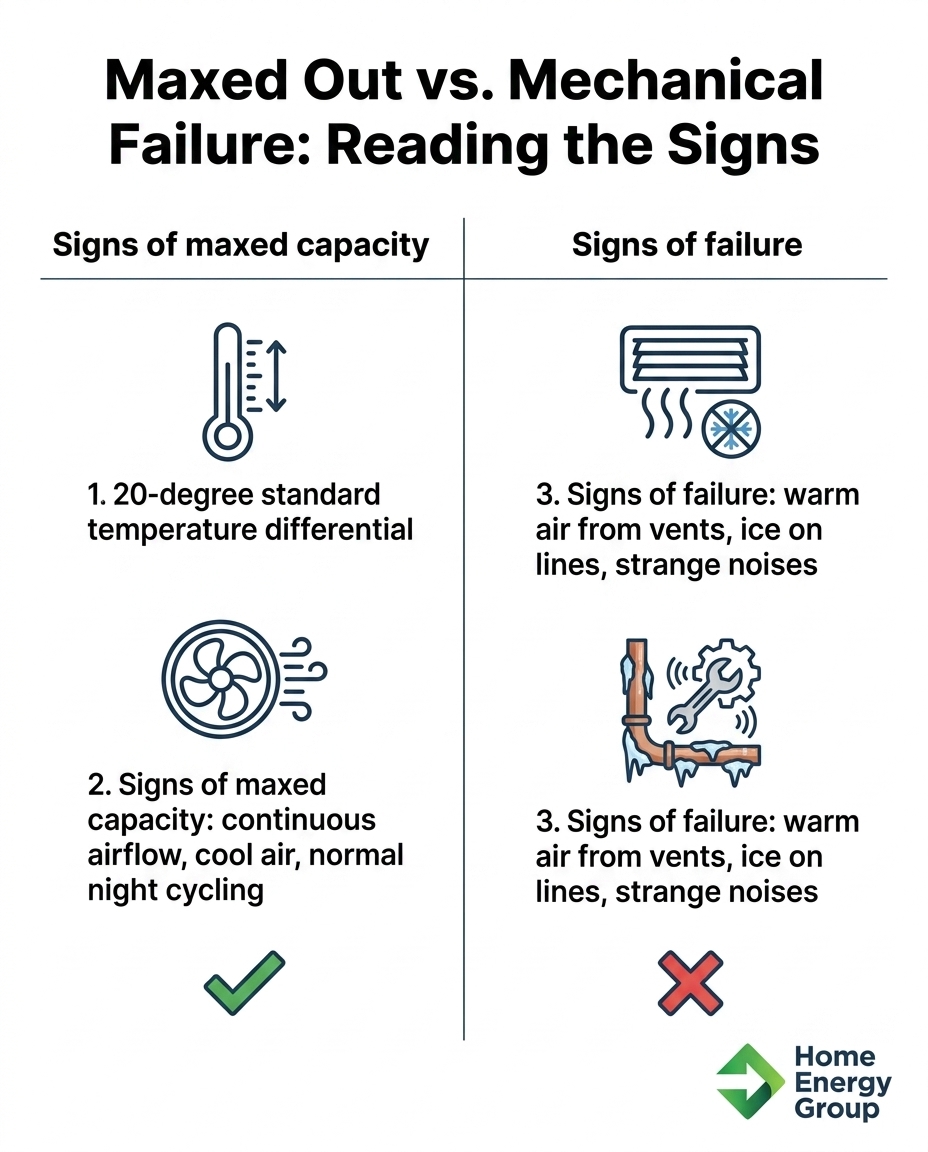
If your system is simply maxed out by the weather, you will typically notice a specific pattern of behavior. These signs indicate that the equipment is functioning, but the thermal load is just too high:
• Continuous, steady airflow: The air coming from your vents is flowing strongly and consistently without sputtering.
• Air is cool, but not freezing cold: The air exiting the registers feels cooler than the room temperature, even if it isn't cold enough to overcome the extreme outdoor heat.
• Normal nighttime recovery: Once the sun goes down and the outdoor temperature drops, the system eventually catches up, cools the house to your desired setting, and resumes normal on-and-off cycling.
• No unusual sounds: The system sounds exactly like it always does—just a steady hum of the blower motor and the outdoor compressor.
Red Flags of Actual Mechanical Failure
On the other hand, if a component has failed, the system will exhibit very different symptoms. Based on our years of diagnosing summer breakdowns, continuous operation combined with any of the following warning signs indicates a definite need for professional intervention:
• Warm air blowing from vents: If the air coming out of your registers is room temperature or actively warm, the cooling process has stopped entirely.
• Strange, loud noises: Grinding, squealing, hissing, or loud banging sounds point to failing motors, broken belts, or severe pressure issues.
• Sudden spikes in indoor humidity: Air conditioners naturally dehumidify as they cool. If your home suddenly feels like a swamp, the evaporator coil is likely not functioning.
• Short cycling: If the system turns on for two minutes, shuts off, and immediately turns back on, the compressor is likely protecting itself from a severe failure.
The 24-Hour Rule: We always advise monitoring your system's behavior over a full 24-hour cycle. Panicking at 4:00 p.m. when the sun is beating down on your roof is natural, but if the system recovers by midnight, you likely just experienced a max-capacity event rather than a breakdown.
Recognizing the Warning Signs of a Frozen Evaporator Coil
In our daily service calls, one of the most common mechanical failures we encounter that causes a system to run continuously without actually cooling the house is a frozen evaporator coil. This happens when the indoor portion of your air conditioner gets too cold and literal ice builds up over the components, completely blocking the cooling process.
What a Frozen Coil Looks and Acts Like
When an evaporator coil freezes, the symptoms are usually quite obvious if you know what to look for. You will typically experience severely reduced airflow coming from your vents. Because the coil is encased in a block of ice, air cannot physically pass through it. Eventually, the little air that does make it through will feel warm. If you look at the indoor unit or the copper refrigerant lines running outside, you might see thick white frost or solid ice buildup, even on the hottest day of the year.
Common Causes of Freezing
Evaporator coils freeze for two primary reasons: restricted airflow or chemical issues. Your system relies on a constant flow of warm house air passing over the cold coils to keep them from dropping below freezing. If a severely clogged air filter blocks that airflow, the coils get too cold and freeze the ambient humidity. Alternatively, if the system is experiencing chemical issues within the closed loop, the pressure drop can cause the coils to flash-freeze.
In one real-world instance, our dispatch team received a frantic call from a property manager overseeing multiple rental properties during the summer heat. They noticed rapid cooling loss across several units. Our remote troubleshooting revealed severe airflow restrictions caused by neglected filters. Home Energy Group technicians were dispatched within an hour to resolve the airflow issues and thaw the systems before the coils completely froze over, saving the equipment from lasting damage.
Why You Must Never Chip the Ice
A critical warning: Never try to chip away the ice with a tool, and never pour hot water over the components. The fins on an evaporator coil are incredibly delicate, and puncturing them will ruin the unit. Furthermore, continuing to run the system while it is frozen can cause liquid to flow backward into the outdoor compressor, destroying the most expensive part of your system. If you notice severe failures, you may eventually need to evaluate broader system replacements, such as replacing just the AC condenser.
Safe Troubleshooting Steps You Can Take Today
Before you pick up the phone to schedule professional air conditioning repair, there are several safe, actionable steps you can take to diagnose the issue. Often, continuous running is caused by something simple that we find homeowners can fix in five minutes.
Your Safe Troubleshooting Checklist
1. Check and replace dirty air filters: This is the single most important step. A severely clogged filter chokes the blower motor, restricts airflow, and is the leading cause of frozen coils. Pull your filter out and hold it up to a light. If you cannot see light through it, replace it immediately.
2. Verify thermostat settings: It sounds obvious, but double-check that your thermostat is actually set to "cool" and not "heat" or "off." Additionally, ensure the fan setting is switched to "auto" rather than "on." If the fan is set to "on," it will blow continuously even when the cooling cycle has stopped, making it feel like the AC never shuts off.
3. Inspect the outdoor condenser unit: Walk outside and look at the large metal box sitting in your yard. It needs to breathe to exhaust the heat from your home. Clear away any encroaching bushes, tall grass, or debris. Ensure there is at least two feet of clear space around all sides of the unit.
4. Check the circuit breakers: Sometimes the indoor blower is running, but the outdoor condenser has tripped a breaker. Check your electrical panel to ensure the AC breaker hasn't flipped to the neutral position.
What to avoid: We emphasize safety above all else. Checking chemical levels, opening the high-voltage electrical panel on the outdoor unit, or testing capacitors requires specialized training and tools. Leave these tasks strictly to a licensed professional to avoid serious injury or further damage to the equipment.
How a Seasonal Home Maintenance Checklist Prevents Mid-Summer Breakdowns
We always tell our customers that the best way to handle a mid-summer cooling crisis is to prevent it from happening in the first place. Connecting the troubleshooting steps back to proactive care highlights exactly why routine maintenance is so crucial. A comprehensive seasonal home maintenance checklist is your first line of defense against frozen coils and overworked compressors.
The Value of Proactive Cleaning and Tuning
Routine cleaning of the evaporator coils and checking of the blower motor prevents the exact conditions that lead to freezing. When one of our professional technicians performs a seasonal tune-up, they clear away the microscopic dust and grime that act like an insulating blanket on your coils. They also test electrical connections and ensure the system operates at its peak efficiency. A highly efficient system handles heavy thermal loads much better, cooling your home faster and shutting off sooner.
Efficiency, Upgrades, and Peace of Mind
Maintaining high efficiency doesn't just keep you comfortable; it can sometimes help homeowners qualify for generic energy rebates or utility incentive programs that reward reduced energy consumption. Federal tax credits may also apply to qualifying high-efficiency heat pump upgrades, though we always advise you to verify current programs with your utility provider or a tax professional.
Sometimes, routine maintenance checks reveal that older equipment can no longer handle the summer load safely. Upgrading doesn't have to be a drawn-out nightmare. In one recent project, our team found that an older system could no longer keep up. We quoted and installed a modern ductless heat pump system efficiently, taking just a few hours to complete on installation day. The peace of mind that comes from knowing your system has been professionally prepped for the heat, or swiftly upgraded when necessary, is invaluable. To keep your equipment running smoothly year after year, consider enrolling in our routine AC maintenance plan.
When to Stop Troubleshooting and Call a Local Expert
There is a clear boundary between safe homeowner checks and the need for professional repair. Knowing when to stop troubleshooting is just as important as knowing where to start.
Recognizing the Limits of DIY
We want to state clearly: if the air filter is brand new, the outdoor unit is completely clear of debris, the thermostat is set correctly, and the system still blows warm air or freezes over, it is time to call an expert. Continuing to run a struggling system or attempting to dig into the electrical components yourself is highly dangerous and can void your manufacturer warranty.
We cannot overstate the dangers of DIY chemical handling or electrical work. The capacitors inside an air conditioning unit hold a lethal electrical charge long after the power is turned off. Only a trained technician knows how to discharge them safely.
What to Expect from a Professional Diagnostic
When a Home Energy Group expert arrives at your door, they will perform a thorough diagnostic visit. We use specialized gauges to check operating pressures, multimeters to test electrical draw, and temperature probes to measure the exact temperature differential across your coils. Working with our team means you are relying on reliable, expert technicians who provide honest diagnostics without pushing unnecessary repairs. We will tell you clearly whether your system is simply fighting a losing battle against a 100-degree day, or if a specific part has failed and needs replacement.
If you are experiencing continuous running with warm air, it is time to reach out. Check our local service areas to see how quickly a technician can be dispatched to your home.
Restoring Your Home's Comfort Safely
Understanding the fundamental difference between a maxed-out cooling system and a broken one empowers you as a homeowner. By recognizing the 20-degree rule and paying attention to specific warning signs like frozen coils or warm airflow, you can avoid mid-summer panic and make informed decisions.
At Home Energy Group, our goal is to ensure you have a clear, objective breakdown of your system's behavior as the first step to restoring comfort. Whether it simply involves changing an air filter, following your seasonal home maintenance checklist, or bringing in our experts to diagnose a mechanical failure, you now have the knowledge to handle the heat. If you suspect your continuous cooling cycles are pointing to a real breakdown, reach out for professional guidance today.
Frequently Asked Questions
Why is my AC running constantly but not cooling the house?
If your AC runs constantly but the house remains warm, it is either maxed out by extreme outdoor temperatures or suffering from a mechanical issue. During severe heatwaves, systems run continuously just to maintain a 20-degree difference from the outside air. However, if the air coming from the vents is warm, you likely have a clogged filter, a frozen coil, or a pressure issue requiring professional repair.
At what outside temperature does an AC struggle to cool?
Most standard residential air conditioners begin to struggle when outdoor temperatures exceed 95 degrees Fahrenheit. Because systems are designed to cool the indoor air by about 20 degrees relative to the outside, a 100-degree day means the system will fight hard just to keep the house at 80 degrees. At these extreme temperatures, continuous operation is normal and expected.
How do I know if my AC coil is frozen?
A frozen AC coil typically presents with severely reduced airflow from your vents and air that feels warm rather than cold. You may also see visible white frost or solid ice buildup on the copper lines running to your outdoor unit or around the indoor air handler. If you suspect a frozen coil, we recommend turning the cooling setting off immediately and leaving the fan running to help it thaw safely.
When should I call for professional AC repair?
We suggest calling for professional repair if you have already changed your air filter, cleared debris from the outdoor unit, and verified your thermostat settings, but the system still blows warm air. Additionally, loud grinding noises, visible ice on the system, or electrical breakers that constantly trip are immediate signs that you need a licensed technician.
Will pouring hot water on a frozen AC coil fix it?
No, pouring hot water on a frozen AC coil will not fix the underlying problem and is highly dangerous to the equipment. The rapid temperature change can warp or rupture the delicate metal components, and the water can damage surrounding electrical parts. The safest way to thaw a coil is to turn off the cooling function, turn the fan to "on," and let the ambient air melt the ice naturally.
How long should an AC run during a summer heatwave?
During a severe summer heatwave, it is completely normal for an air conditioner to run continuously for several hours during the peak afternoon heat. As long as the air coming from the vents is cool and the system eventually shuts off and resumes normal cycling after the sun goes down, the continuous running is simply the system handling its maximum thermal load.




