
Balancing Indoor Humidity as the Pacific Northwest Rains Return

Navigating the Fall Climate Clash Inside Your Home
Before the first heavy autumn downpour hits, there is a distinct shift in the air. Figuring out the secret to balancing indoor humidity as the Pacific Northwest rains return is a challenge for many local homeowners who find themselves caught in a frustrating seasonal paradox. You turn on the heat to chase away the morning chill, which instantly dries out the air circulating through your living spaces. Yet, at the exact same time, the returning rains drastically increase the moisture levels right outside your front door, leading to a strange phenomenon where your home feels parched, but your windows are dripping with condensation.
This "wet outside, dry inside" dynamic forces you into a difficult decision point during the September heating season transition. Do you need to add moisture to relieve scratchy throats and dry skin, or do you need to improve ventilation to stop your windows from sweating? Diagnosing this imbalance early is the key to protecting your home's interior finishes, preventing mold growth, and keeping your family comfortable all winter long. By exploring professional indoor air quality solutions and considering advanced options like heat recovery ventilation systems, you can solve these conflicting symptoms before the deep winter freeze sets in.
The Building Science Behind the 'Wet Outside, Dry Inside' Paradox
The underlying problem: To understand why your house feels so confusing during the fall, you have to look at the relationship between temperature and airborne moisture. Relative humidity measures how much water vapor the air is currently holding compared to the maximum amount it could hold at that specific temperature. Warm air can hold significantly more moisture than cold air.
The mechanical cause: Starting in late September, Brush Prairie and the greater Clark County area experience a rapid increase in precipitation and atmospheric moisture. The outdoor air might be a chilly 45°F with a relative humidity of 85%. However, when that cold outdoor air naturally infiltrates your house and is heated to 70°F by your forced-air furnace, the air expands. Its capacity to hold water increases dramatically, which means that same amount of moisture now represents a much lower relative humidity—often plummeting down to 15% or 20%. This creates an aggressively drying effect inside your living spaces.
The modern construction complication: This dynamic behaves differently depending on the age of your house. Older, draftier homes lose moisture rapidly to the outdoors, meaning they almost always suffer from extreme dryness during the heating season. Modern, well-sealed homes, however, present a different challenge. Because they are built tight to conserve energy, they trap all the existing indoor moisture generated by daily living—cooking pasta, taking hot showers, and even just breathing. When you close all your windows for the season, that stale, damp air has nowhere to escape.
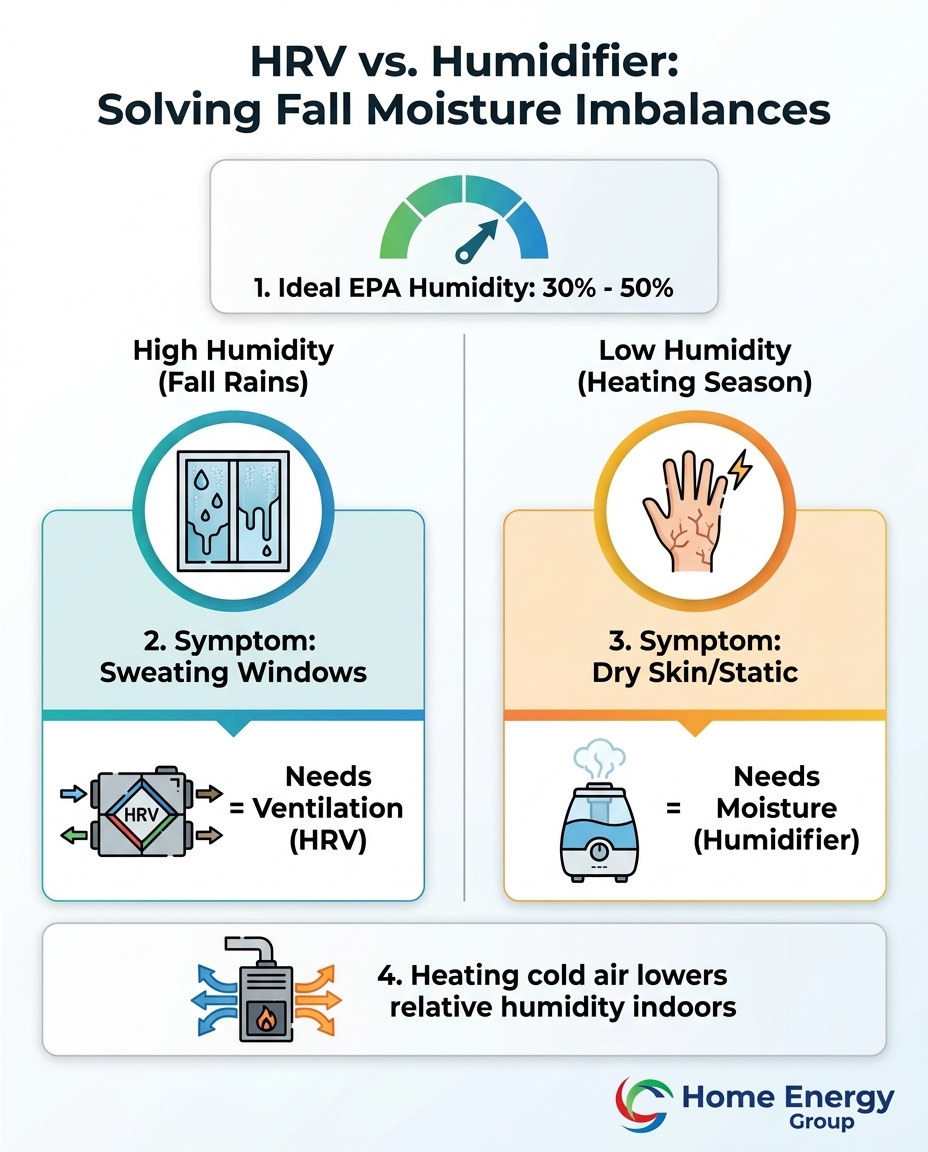
The scientific solution: We focus on building science to help you understand these hidden dynamics rather than just pushing a quick product installation. The Environmental Protection Agency (EPA) recommends maintaining your indoor relative humidity between 30% and 50% for optimal health and comfort. Falling below this range damages wood floors and irritates respiratory systems, while rising above it encourages mold and dust mites. Achieving this exact balance requires evaluating your home's unique airflow patterns.
Identifying Your Home's Unique Moisture Symptoms
Because every house breathes differently, your home will display specific physical signs indicating whether it is too dry, too damp, or suffering from poor air exchange. During the September heating season transition, take a walk through your house and look for these telltale symptoms to help diagnose your specific indoor air quality issue.
• Sweating windows and pooling condensation: If you wake up to find water droplets covering the inside of your bedroom windows or pooling on the window sills, your home is trapping too much moisture. This indicates a severe lack of ventilation. The warm, damp indoor air is hitting the cold glass, reaching its dew point, and turning back into liquid water.
• Dry skin, scratchy throats, and static shocks: If you are constantly applying lotion, waking up with a sore throat, or getting zapped every time you touch a metal doorknob, your indoor air is excessively dry. This indicates that your heating system has stripped the moisture from the air and you lack proper humidification.
• Stale odors and lingering cooking smells: If last night's dinner still smells strongly in the kitchen the next morning, or if certain rooms have a heavy, stuffy odor, your home has poor air exchange. The same air is simply being recirculated without any fresh oxygen being introduced.
• Warping wood and shifting doors: Hardwood floors that begin to gap, or interior doors that suddenly refuse to latch properly, are physical reactions to extreme swings in humidity. Wood acts like a sponge, expanding when damp and shrinking when parched.
It is entirely possible for a home to experience a combination of these symptoms. For example, a poorly balanced two-story house might have a bone-dry downstairs living room where the furnace runs constantly, while the upstairs bedrooms suffer from severe window condensation because the warm, moist air naturally rises and gets trapped against the ceiling.
Whole-Home Humidifiers: Combating Furnace-Dried Air
If your home's primary symptoms revolve around dry skin, static electricity, and shrinking woodwork, the most effective solution is a whole-home humidifier. Unlike the small, portable room humidifiers you might place on a nightstand, a whole-home system integrates directly into your existing HVAC ductwork to treat every cubic foot of air in the house simultaneously.
How the technology works: As part of your heating system preparation, a humidifier is typically mounted directly to your furnace. When the system calls for heat, water flows over a specialized evaporator pad inside the humidifier. The hot air from the furnace blows through this water-soaked pad, absorbing water vapor. This newly moisturized air is then distributed evenly through your home's supply registers.
The advantage over portable units: Portable humidifiers require constant refilling, only treat a single room, and often leave white mineral dust on your furniture. They also pose a localized mold risk if they over-saturate a small area. A whole-home system is plumbed directly into your home's water supply, meaning there are no tanks to carry or fill. The moisture is distributed evenly, preventing any single room from becoming too damp.
Smart controls and outdoor sensors: One of the most important features of a modern whole-home humidifier is its automatic control system. In Brush Prairie and the greater Pacific Northwest, outdoor temperatures can swing wildly during the fall. If your indoor humidity remains at 45% when the outdoor temperature suddenly drops to freezing, your windows will instantly ice up. Advanced humidistats use outdoor temperature sensors to automatically scale back the indoor humidity as the weather gets colder, ensuring you stay comfortable without accidentally creating a condensation nightmare.
Heat Recovery Ventilators: Curing Condensation and Stale Air
If your home is tightly sealed and suffers from sweating windows, lingering odors, and a general feeling of stuffiness, adding a humidifier will only make the problem worse. What you actually need is a way to exhaust that trapped moisture and bring in fresh air—without losing all the heat you just paid your furnace to generate. This is where a Heat Recovery Ventilator (HRV) becomes invaluable.
An HRV is a mechanical ventilation system that continuously exchanges stale indoor air for fresh outdoor air. Here is exactly how the process works to cure condensation without sacrificing energy efficiency:
1. Extraction of stale air: The HRV pulls warm, damp, and stale air from the most moisture-heavy rooms in your home, typically the bathrooms, kitchen, and laundry room.
2. Intake of fresh air: Simultaneously, the system draws in cool, fresh—but often damp—outdoor air from outside the house.
3. The heat exchange core: Both airstreams pass through a highly engineered cross-flow heat exchange core. The two airstreams never physically mix, so contaminants and odors are not transferred. However, the heat from the outgoing indoor air is transferred to the incoming outdoor air.
4. Distribution of tempered air: The now-warmed fresh air is distributed throughout your living spaces, while the stale, moisture-laden air is exhausted outside.
Because the HRV recovers the vast majority of the heat energy that would otherwise be lost by simply opening a window, it is the ultimate solution for window condensation in modern construction. In fact, ASHRAE Standard 62.2, the recognized standard for residential ventilation, strongly emphasizes the necessity of mechanical ventilation in tightly sealed homes to maintain safe indoor air quality.
Diagnosing the need for an HRV requires a custom, science-based approach to understand your home's specific airflow. One local homeowner reached out during a recent September heating season transition when their house, which had remnants from three previous HVAC systems, struggled with severely poor air exchange and lingering odors. Our team deduced the specific airflow needs and installed a highly efficient system with a clear plan of action, completely resolving the stale air issues and restoring a healthy balance to the home.
Making the Choice: HRV, Humidifier, or Both?
Deciding between these two solutions comes down to reading the specific signs your house is giving you. The general rule of thumb is straightforward: if the house is painfully dry, add a humidifier; if the house has sweating windows and stale air, add an HRV.
To help you navigate this decision, review the comparison matrix below:
• Sweating windows, peeling paint, mold spots — Best Solution: Heat Recovery Ventilator (HRV) — Primary Benefit: Exhausts trapped moisture and brings in fresh air
• Static shocks, dry skin, cracking wood floors — Best Solution: Whole-Home Humidifier — Primary Benefit: Adds necessary water vapor to furnace-dried air
• Modern, tightly sealed, energy-efficient home — Best Solution: Heat Recovery Ventilator (HRV) — Primary Benefit: Provides required mechanical ventilation without heat loss
• Older, drafty home with poor insulation — Best Solution: Whole-Home Humidifier — Primary Benefit: Compensates for rapid moisture loss through leaky walls
• Lingering cooking odors and stuffy air — Best Solution: Heat Recovery Ventilator (HRV) — Primary Benefit: Exchanges stale indoor air for oxygen-rich outdoor air
Handling edge cases: In some situations, a home in Brush Prairie and the greater Pacific Northwest might actually need both systems. Large homes with distinct zones, varying levels of insulation, or complex multi-story layouts can experience trapped moisture upstairs and severe dryness downstairs.
Because every building envelope is different, the most critical next step is scheduling professional testing. Using specialized hygrometers and airflow diagnostics, an expert can measure your current indoor relative humidity and determine exactly what equipment will solve your problem. If you are already considering replacing your furnace in Washington state, this transition period is the perfect time to integrate proper air quality controls into your new system installation.
Frequently Asked Questions About Fall Indoor Air Quality
Why are my windows sweating on the inside?
Your windows sweat because warm, moisture-heavy indoor air is hitting the cold glass surface and reaching its dew point. This physical reaction turns airborne water vapor back into liquid droplets. In tightly sealed homes, this is a major indicator that you have excessive indoor moisture trapped inside with no mechanical ventilation to let it escape.
Do I need an HRV or a humidifier?
The choice depends entirely on whether your home is too dry or trapping too much moisture. Humidifiers add water vapor directly to the airflow to alleviate dry air, static shocks, and scratchy throats. HRVs, on the other hand, exhaust stale, damp air to the outside and bring in fresh air, which reduces window condensation and clears out lingering odors.
What is the ideal indoor humidity in the fall?
The EPA strongly recommends keeping your indoor relative humidity between 30% and 50%. Maintaining your home within this specific range prevents harmful mold and mildew growth while still providing enough moisture to avoid dry skin, irritated sinuses, and damage to hardwood floors or wooden furniture.
How do I increase humidity in my house naturally?
You can introduce small amounts of moisture by leaving the bathroom door open after taking a hot shower. Additionally, air-drying your clothes on indoor racks and adding a variety of leafy houseplants can naturally release water vapor into the surrounding air. However, these methods are often not enough to combat the intense drying effect of a furnace running full-time.
Can my furnace dry out the house even if it's raining outside?
Yes, your furnace absolutely dries out the house regardless of outdoor precipitation. Heating cool outdoor air causes it to expand, which drastically lowers its relative humidity. This means that even during a heavy autumn downpour, the air circulating through your vents will create a severe drying effect inside your living spaces.
Achieve Perfect Balance Before the Deep Winter Hits
Achieving true comfort during the September heating season transition requires a balanced, scientific approach to both ventilation and humidification. Treating the symptoms of the "wet outside, dry inside" paradox early in the fall is the best way to prevent major discomfort, protect your woodwork, and avoid mold growth when the deep winter weather finally arrives.
Because every house in Brush Prairie and the greater Pacific Northwest has a unique building envelope, guesswork will only lead to frustration. We encourage you to seek a professional evaluation to measure your exact relative humidity and airflow needs. Reach out to an indoor air quality expert today to schedule a thorough assessment, and discover the tailored solutions that will keep your home healthy, balanced, and perfectly comfortable all season long.