Protecting Outdoor HVAC Equipment from Fall Debris and Falling Branches in Amboy
The Urgent Need to Shield Your System Before the Storms Hit
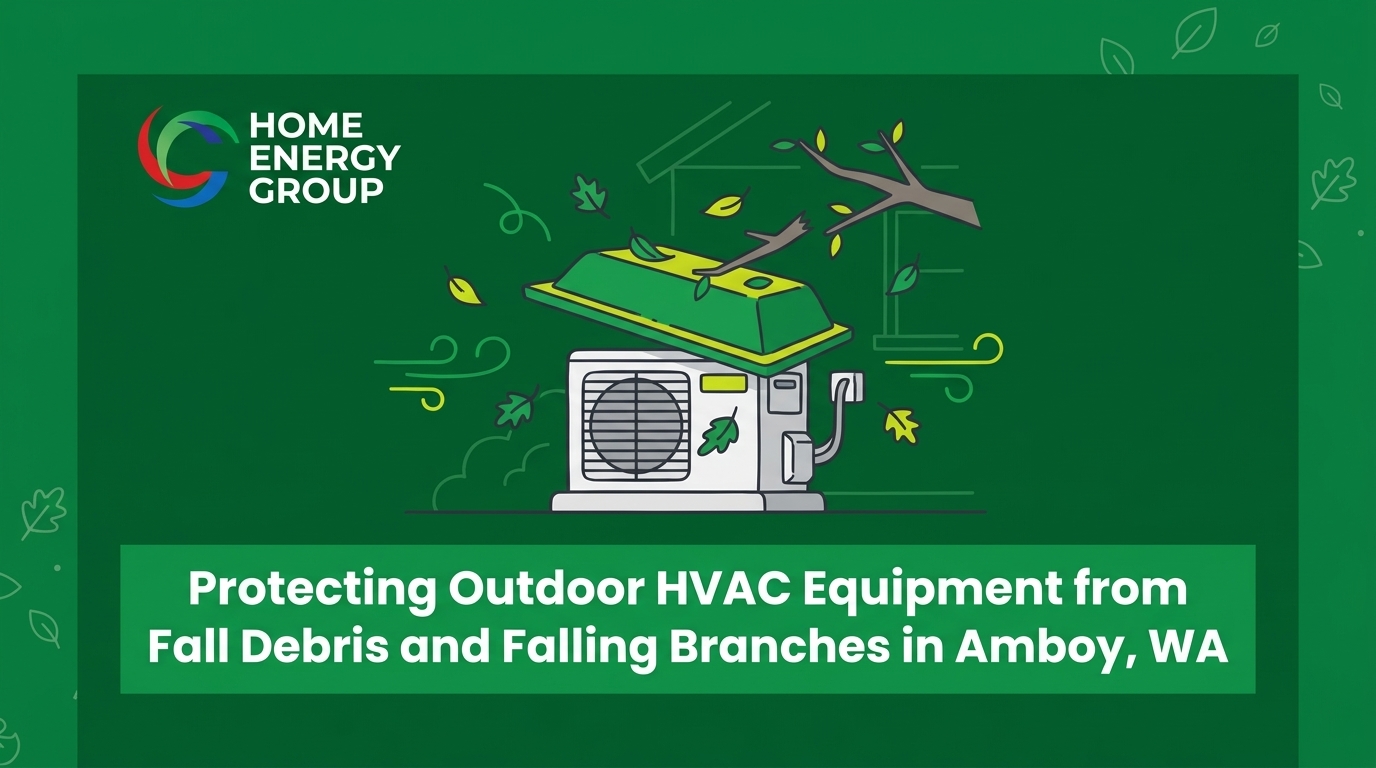
Your outdoor condenser is built to withstand standard weather, but as the September pre-heating season arrives, a different kind of threat begins to pile up. At Home Energy Group, we've seen first-hand how quickly late-summer overgrowth turns into a costly problem. Protecting outdoor HVAC equipment from fall debris and falling branches in Amboy is a race against time before early fall storms hit. High winds frequently snap dead branches, while heavy foliage creates a suffocating blanket over your system right when you need it to transition efficiently into heating mode. Ignoring the accumulation of leaves and twigs around your unit is one of the fastest ways to invite premature mechanical failure.
The core conflict every homeowner faces during this transition is figuring out how to shield the unit from physical damage without choking off the vital airflow it requires to operate. Heavy Pacific Northwest rain and wind storms typical of September drop massive debris loads, turning a small pile of dry leaves into a dense, wet, impenetrable barrier. When a system cannot pull in enough air, it works harder, runs hotter, and ultimately costs more to operate.
Acting now, before heating demands peak, prevents catastrophic damage to the condenser fan and delicate internal coils. A proactive approach to yard maintenance and system preparation ensures your equipment survives the shift in seasons intact.
Whether you are evaluating your current air conditioning equipment or looking to secure a comprehensive HVAC maintenance plan, professional preparation is the smartest way to weather the upcoming storms.
The Short Window for Pre-Season Preparation
The gap between the last hot days of summer and the first freezing nights of late fall is surprisingly brief. During this window, your system sits largely idle, making it the perfect time to clear away the summer's overgrowth. Waiting until the first major windstorm strikes means you are reacting to a problem rather than preventing one. Falling branches can dent the cabinet, damage the fan blades, and even sever the refrigerant lines if the impact is severe enough.
By taking action in early September, you establish a defensive perimeter around your equipment. This not only protects the physical hardware but also ensures that when you finally switch the thermostat over to heat, the system breathes freely and operates at peak efficiency.
Understanding the Threat: Pine Needles, Wet Leaves, and Coil Corrosion
Standard yard waste is a nuisance, but the specific flora found in wooded residential properties in Amboy poses a much more aggressive threat to your heating and cooling equipment. The Pacific Northwest is home to towering Douglas Firs and Hemlocks, trees that drop an abundance of highly acidic needles. When these needles accumulate inside your HVAC cabinet, they do much more than just block airflow—they actively degrade the metal components. In our years of servicing systems across the Brush Prairie and Amboy areas, our team consistently finds that wet leaves and acidic pine needles are leading culprits behind early coil corrosion.
Continuous autumn rain exacerbates the problem by preventing this debris from drying out and blowing away naturally. Instead, the wet leaves and needles form a soggy, decaying mat at the base of the unit and against the aluminum fins.
The Chemistry of Wet Leaf Decay
As organic matter breaks down, it releases tannic acids. When wet leaves are plastered against the delicate aluminum fins and copper tubing of your condenser coil, these acids initiate a process of galvanic corrosion. Over time, the metal weakens, leading to microscopic refrigerant leaks that are notoriously difficult to locate and repair.
• Acidic accumulation: Pine needles carry high acidity that strips away the protective coatings on internal wiring and metal coils.
• Moisture trapping: A dense layer of wet leaves prevents the sun and wind from drying out the base pan, encouraging rust to form on the steel cabinet bottom.
• Bypassing standard grilles: Unlike large broad leaves, slender pine needles easily slip through the protective outer louvers of the cabinet, building up directly on the fan motor and compressor.
• Fungal growth: Decaying organic matter in a dark, wet environment promotes mold and mildew, which can eventually impact the air quality if drawn into the home's ductwork (in the case of packaged units).
Understanding the unique chemical and physical threats posed by regional vegetation highlights why a quick pass with a rake is often not enough. The combination of continuous rain and acidic debris requires a more thorough and strategic approach to property maintenance.
The 2-3 Foot Clearance Rule for Outdoor Units
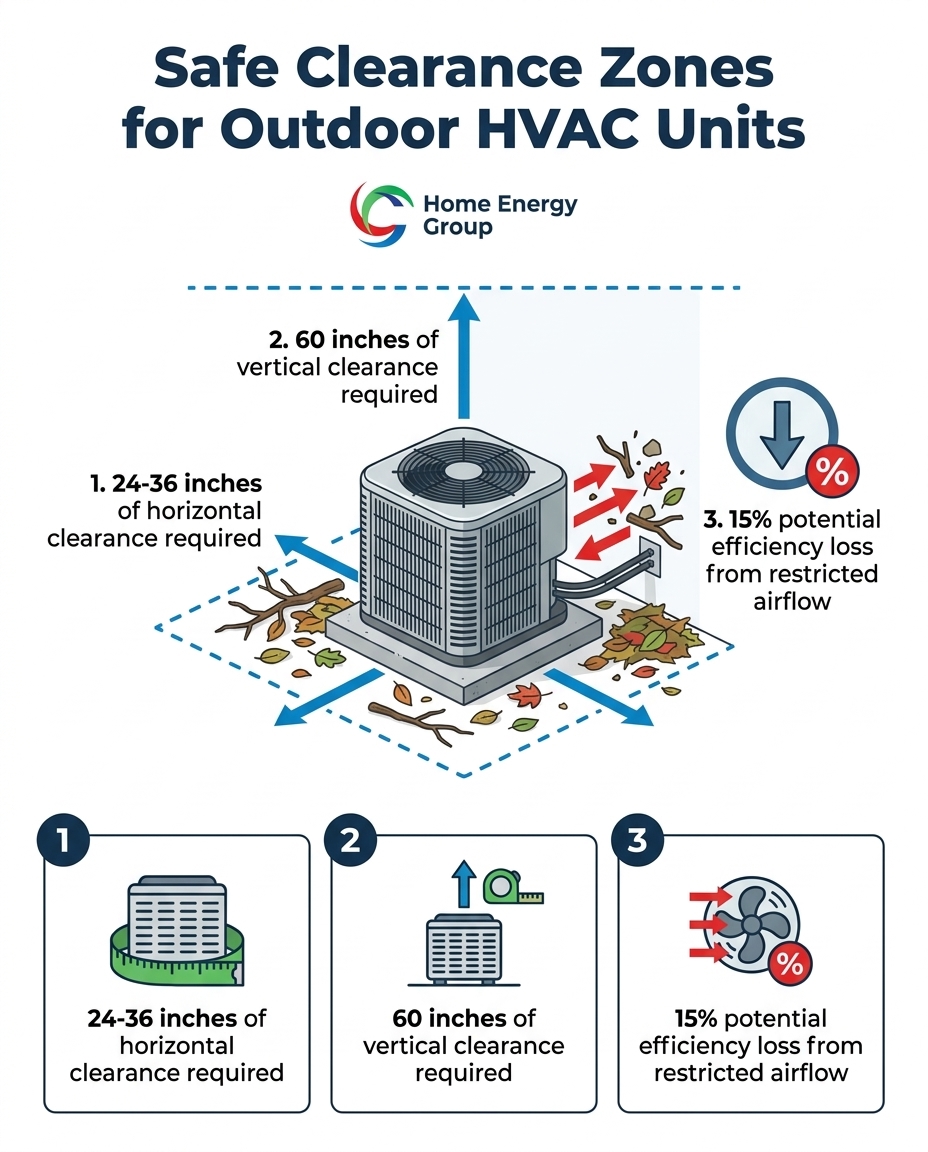
To operate safely and efficiently, an outdoor heat pump unit or air conditioner must be able to pull massive volumes of air through its side panels and exhaust hot air out the top. HVAC manufacturers universally require a minimum of 24 to 36 inches of horizontal clearance around the entire outdoor condenser. Furthermore, the space directly above the unit must remain clear for at least 60 inches to prevent exhausted air from bouncing off a low canopy and being recirculated back into the system.
As the local experts at Home Energy Group, we believe in providing precise, manufacturer-approved landscaping clearance rules rather than just waiting to sell reactive repairs when a suffocated system finally breaks down. Department of Energy (DOE) guidelines indicate that restricted airflow can cause system efficiency to drop by up to 15 percent, driving up your monthly utility bills significantly.
Steps to Establish the Safe Clearance Zone
1. Measure the perimeter: Use a tape measure to mark a 36-inch radius entirely around the concrete pad supporting your unit.
2. Trim back aggressive shrubs: Cut back any bushes, ornamental grasses, or hedges that have encroached into this zone over the summer.
3. Evaluate vertical clearance: Look directly above the unit. Prune away any low-hanging branches that sit within 60 inches of the top fan grille.
4. Clear the ground cover: Rake away mulch, gravel, and fallen leaves from the immediate base of the unit to ensure water can drain away from the cabinet properly.
Maintaining this clear zone on wooded residential properties in Amboy is an ongoing task, especially during the heavy leaf drops of autumn. Regular checks ensure that the system can always breathe easily, protecting the compressor from the strain of air starvation.
Why Tight-Fitting Covers Are a Mistake in the Pacific Northwest
When the September pre-heating season and early fall storms arrive, a homeowner's first instinct is often to protect their investment by wrapping the outdoor unit in a heavy-duty tarp or a tight-fitting canvas cover. While this might seem like a logical way to block falling branches and keep leaves out, it is actually one of the most damaging things you can do in a wet climate.
The Problem: Generic, tight-fitting covers do not allow the system to breathe. In dry climates, a cover might serve as a harmless dust shield. However, in the wet Washington climate, a full wrap becomes a moisture trap.
The Cause: Ground moisture constantly evaporates upward. When a tight cover blocks this evaporation, condensation forms on the inside of the canvas. This traps a highly humid microclimate directly against the metal cabinet, electrical contactors, and copper coils. The resulting rapid rust and electrical corrosion can destroy a unit from the inside out in a single season. Furthermore, a dry, covered box shielded from the wind creates an incredibly inviting winter shelter for rodents and pests. Mice frequently nest inside covered units, chewing through low-voltage wiring and leaving behind corrosive waste.
The Solution: Instead of wrapping the entire unit, use a manufacturer-approved top-only debris guard. These heavy-duty mesh or rigid plastic shields sit exclusively over the top fan grille. They effectively deflect falling branches, acorns, and large leaves while leaving the side panels completely open. This allows the wind to blow through the cabinet, keeping the internal components dry and making the space inhospitable to nesting rodents.
Preventative Landscaping: Deflecting Branches Safely
Protecting your equipment from physical impact requires looking up and looking around. Preventative landscaping is about strategically managing the environment around your home so that when high winds sweep through your Amboy HVAC service area, your condenser is not in the line of fire.
The most severe damage typically comes from dead or dying branches that snap during the first major gale of the season. Identifying high-risk trees and scheduling pre-season pruning is a critical first step. An arborist or professional tree service can thin the canopy above your unit, reducing the wind resistance of the tree and removing heavy limbs that threaten the equipment below.
Strategic Windbreaks and Fencing
For wooded residential properties in Amboy, installing a strategic windbreak can significantly reduce the amount of flying debris that strikes the cabinet.
• Lattice fencing: A sturdy lattice fence placed three feet away from the unit on the windward side can catch blowing leaves and deflect smaller branches before they impact the coils.
• Evergreen screens: Planting a row of dense, sturdy evergreens can buffer high winds, provided they are planted far enough back to respect the 3-foot clearance rule at their full mature width.
• Post-storm walkthroughs: Make it a habit to walk your yard immediately after a major weather event. Clear away any debris that has piled up against the windbreaks to ensure they continue to function properly without eventually spilling over into the HVAC clearance zone.
By managing the canopy and establishing physical barriers at a safe distance, you can drastically reduce the risk of impact damage without ever compromising the system's ability to breathe.
The Hidden Costs of Choked Airflow
When fall debris is allowed to accumulate and block the condenser coils, the consequences go far beyond a messy yard. The refrigeration cycle relies entirely on the efficient transfer of heat. If the outdoor unit cannot pull enough air across its coils, it cannot release the heat it absorbed from inside your home (or, in the case of a heat pump in winter, it cannot absorb heat from the outside air).
This air starvation leads to a dangerous cascade of mechanical failures. The most immediate impact is a severe spike in compressor operating temperatures. The compressor is the heart of your system, and it relies on the cool refrigerant returning from the evaporator coil to keep its internal motor from overheating. When airflow is choked, the entire system runs hotter and longer, leading to the immense strain on an AC running continuously with blocked airflow.
Signs Your System is Straining
Homeowners often notice the secondary effects of airflow restriction before they realize the unit is blocked. If your system is struggling against a blanket of September pre-heating season and early fall storms debris, you will likely experience:
• Spiking energy bills: The system draws significantly more amperage as it struggles to achieve the target temperature.
• Lukewarm air at the vents: Reduced heat transfer efficiency means the air blowing into your rooms will not feel as crisp or as warm as it should.
• Short-cycling: The compressor's internal thermal overload switch may trip, causing the unit to shut down abruptly before the house reaches the desired temperature, only to turn back on a few minutes later.
• Unusual noises: A fan motor struggling against physical blockages (like a small branch stuck in the grille) will emit a loud humming or grinding sound.
Reiterating the danger, physical damage to the condenser fan from branches can lead to catastrophic system failure. If a blade bends and strikes the internal coils, it can rupture the copper lines, resulting in a total loss of refrigerant and a massive repair bill.
Exterior Cleanup vs. Professional Internal Cleaning
While preventative landscaping is firmly in the homeowner's domain, cleaning the intricate internal components of an HVAC system requires specialized training. Drawing a clear line between safe DIY exterior cleanup and the necessity of professional internal cabinet cleaning protects both you and your equipment.
During a recent early fall tune-up, our Home Energy Group technicians visited a local Amboy property to address performance concerns. Our team performed a comprehensive system check, evaluated the filter condition, and provided honest feedback on the unit's health, ensuring everything was clean and efficient without the homeowner risking damage by opening the cabinet themselves. This is exactly how the process should work.
Safe Tasks vs. Professional Requirements
• Safe Homeowner DIY — Action: Raking around the concrete base and trimming bushes back 36 inches. — Why It Matters: Maintains the critical clearance zone for optimal airflow and drainage.
• Safe Homeowner DIY — Action: Brushing loose surface leaves off the outer louvers with a soft broom. — Why It Matters: Prevents immediate blockages without bending the delicate aluminum fins.
• Professional Only — Action: Opening the cabinet to extract pine needles packed around the compressor. — Why It Matters: Avoids accidental contact with high-voltage capacitors and delicate wiring.
• Professional Only — Action: Chemically washing the condenser coils. — Why It Matters: Removes acidic sap and tannic acid buildup without using damaging high-pressure water.
A vital warning: Never use a high-pressure power washer on your outdoor unit, and never insert sticks, wire hangers, or tools through the fan grille to fish out debris. High-pressure water will instantly flatten the aluminum fins, blocking airflow permanently, while inserting tools can damage the fan motor or puncture a refrigerant line. An honest assessment of system components by a professional before the cold sets in ensures that wooded residential properties in Amboy are truly prepared for winter.
Frequently Asked Questions About Fall HVAC Protection
Should I cover my outside AC unit in the fall?
No, full covers trap moisture and promote rust. When you wrap a unit tightly in canvas or plastic, ground condensation gets trapped inside, leading to rapid corrosion of the electrical components and metal coils. If you are concerned about falling debris during the September pre-heating season and early fall storms, use a breathable top-guard only to protect the fan grille while leaving the sides open.
How much clearance does an outdoor HVAC unit need?
Maintain 24 to 36 inches of horizontal clearance on all sides of the unit. This spacing ensures the system can pull in enough air to facilitate proper heat transfer. Additionally, you must ensure at least 60 inches of vertical clearance above the unit so that the hot exhaust air is not deflected back down into the system.
How do I protect my outside AC unit from falling branches?
Prune overhanging branches regularly before the storm season begins. Removing deadwood from the canopy above your unit is the most effective preventative measure. You can also install a manufacturer-approved debris shield that deflects impacts from the top without restricting the necessary airflow through the side panels.
Can I put a roof or awning over my AC unit?
Yes, but it must be high enough (at least 5 feet above the top of the unit) to prevent hot air recirculation. If an awning is installed too low, the system will choke on its own exhaust, drastically reducing efficiency and straining the compressor. Always consult a professional to ensure any structural addition meets strict manufacturer specifications.
How do I clean pine needles out of my AC unit?
Clear exterior needles by hand or with a soft brush, gently wiping them away from the outer louvers. Never use a pressure washer or insert tools through the top grille. To remove needles that have bypassed the exterior and settled inside the cabinet, call a professional to safely open the unit, extract the debris, and clean the interior coils.
Secure Your System Before the Next Storm
Balancing the need for debris protection with the strict requirement for proper airflow is the key to keeping your system running efficiently all winter long. By establishing a proper clearance zone, managing the landscaping around your unit, and avoiding the trap of tight-fitting covers, you can defend your equipment against the worst of the seasonal shifts.
However, exterior landscaping is only half the battle. Pine needles, sap, and dust inevitably find their way inside the cabinet, where they can silently corrode your coils and strain your compressor. Encouraging a professional fall tune-up ensures that any hidden internal debris is safely extracted and your system is calibrated for peak performance.
Protecting outdoor HVAC equipment from fall debris and falling branches in Amboy doesn't have to be a guessing game. Secure your peace of mind and explore comprehensive maintenance options by scheduling your HVAC maintenance plan visit today, ensuring your home stays comfortable no matter what the weather brings.