The Hidden Cost of Ignoring Minor AC Condensation Drips in Amboy Homes
That Harmless August Puddle: A Warning Sign for Amboy Homeowners
Late summer in the Pacific Northwest usually brings a welcome stretch of sunshine, but it also brings unexpected humidity that forces your cooling equipment to work overtime. You walk past your indoor unit and notice a small puddle of water forming on the floor. It is incredibly tempting to grab a towel, wipe it up, and assume it is just normal "sweat" from a hard-working system pushing through the August heat. Here is the thing: that harmless-looking puddle is actually a blaring warning sign for Amboy homes. It means water is escaping the system's safety mechanisms and pooling exactly where it shouldn't.
The decision you make in that moment—whether to ignore the minor drip or call a professional—determines what happens next to your floors and walls. If you ignore this minor drip, you are setting the stage for major structural and drywall damage by the time the August to September transition arrives. Understanding how your air conditioning system handles moisture is the first step in protecting your home from hidden water damage.
Why Is My Indoor AC Unit Dripping Water?
To understand why your system is leaking, it helps to understand what it is actually doing. Your air conditioner does not just cool the air; it also dehumidifies it. As warm, humid indoor air blows across the freezing cold evaporator coil, the moisture in the air condenses into water droplets. Think of a cold glass of iced tea sitting on a patio on a hot day—the outside of the glass sweats. Your indoor coil does the exact same thing, but on a massive scale.
According to Department of Energy data, a central air conditioner naturally produces several gallons of condensation per day during periods of high humidity. That water has to go somewhere. It drips off the coil into a drain pan, and then travels safely outside your home through a dedicated pipe. When water pools indoors, it means those safety mechanisms have been overwhelmed or compromised.
The Role of the Condensate Drain Line
The condensate drain line is the unsung hero of your cooling setup. This narrow PVC pipe is responsible for carrying gallons of water away from your interior spaces every single day. However, because it is constantly damp, it is the perfect environment for trouble. Over the course of the cooling season, dust, dirt, pet dander, and biological growth (like algae and mold) can accumulate inside this pipe. Eventually, this creates a sludgy blockage that stops the water from flowing outside, forcing it to back up into the drain pan and eventually overflow onto your floor.
• Normal Condensation — Where You See It: Dripping from the exterior pipe outside your home. — What It Means: Your system is successfully dehumidifying your indoor air.
• Minor Sweating — Where You See It: Slight dampness on the insulated refrigerant lines. — What It Means: Normal temperature differential in humid weather.
• Pooling Water — Where You See It: Puddles on the floor beneath the indoor air handler. — What It Means: A clogged drain line, cracked pan, or failing pump. Needs professional attention.
• Water Stains — Where You See It: Discoloration on the ceiling or drywall near the unit. — What It Means: An active, ongoing leak that is already causing secondary damage.
How Late Summer Humidity Overwhelms Unmaintained Systems
The Pacific Northwest is famous for its mild climate, but the late summer season introduces specific challenges that push cooling equipment to its limits. During the August to September transition, Amboy homes frequently experience unexpected humidity spikes. This sudden shift in weather changes how your system operates, turning it from a simple temperature controller into a heavy-duty dehumidifier.
This timing is critical because it catches homeowners off guard right before the cooling season ends. Here is how the late summer climate specifically impacts your equipment:
• Continuous operation buildup: By the time August arrives, your system has been running continuously for months. All the microscopic dust and airborne particulates it has filtered out have had ample time to settle into the drain pan and wash into the condensate line, creating a thick sludge.
• Sudden moisture demands: When a late summer humidity spike hits, the system suddenly extracts double or triple the normal amount of water from the air. A partially clogged drain line that was draining slowly in July will completely back up under this sudden deluge in August.
• End-of-season fatigue: Systems that skipped their spring tune-up are particularly vulnerable. The biological growth inside the drain line has had the entire summer to multiply, creating a total blockage just as the heaviest moisture load arrives.
This perfect storm of accumulated debris and sudden humidity is why so many indoor leaks happen right at the tail end of the season. The system simply cannot handle the volume of water trying to push through a restricted pipe.
The Rapid Timeline of Hidden Water Damage
A puddle on the floor might seem like a localized issue, but water is incredibly insidious. It does not just sit on the surface; it actively seeks out porous materials. When your AC overflows, the water immediately begins interacting with your home's building materials. The speed and severity of this secondary damage often shock homeowners, transforming a minor HVAC issue into a major structural nightmare.
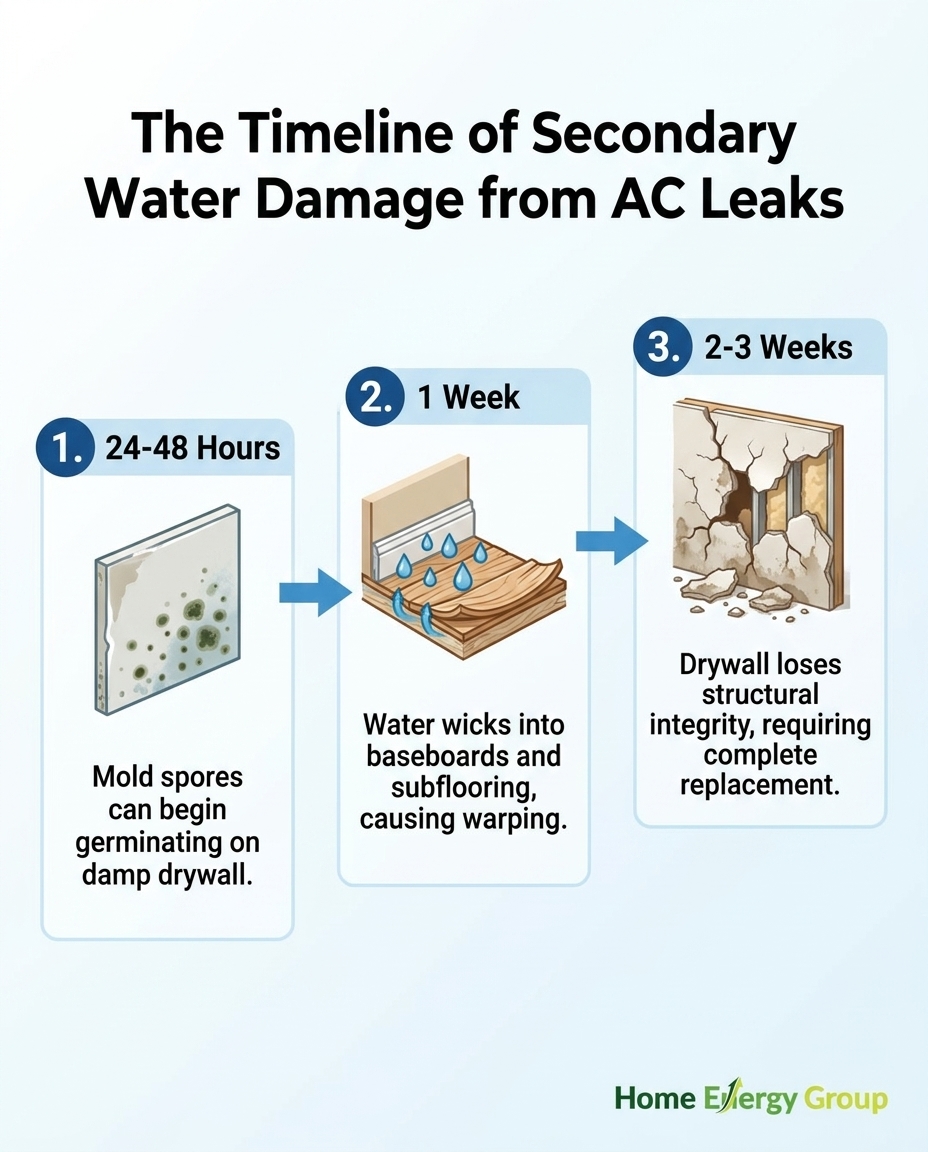
Week 1: The Invisible Spread
Within the first 24 to 48 hours of an overflow, the water begins saturating the subfloor and wicking up into the bottom edge of the surrounding drywall. According to EPA.gov data, mold spores can begin germinating on damp drywall within this exact 24 to 48-hour window. Because the area behind your indoor unit is typically dark and poorly ventilated, it creates an ideal incubator for microbial growth. You might wipe up the visible puddle on the floor, but the moisture trapped inside the wall cavity continues to spread upward and outward.
Week 2-3: Structural Compromise
As the leak continues unnoticed behind the walls, the drywall loses its structural integrity. The paper backing deteriorates, the gypsum core turns to mush, and the paint begins to bubble or peel. Baseboards will start to warp and pull away from the wall. The wooden framing studs behind the drywall absorb the moisture, which can lead to long-term rot. By the time the drywall actually feels soft to the touch or shows visible brown water stains, extensive structural damage has already occurred. What should have been a quick plumbing clearance for the HVAC unit has now evolved into a multi-trade home repair project requiring carpenters and drywall specialists.
Protecting Your Entire Home: Beyond Basic AC Fixes
It is easy to view a dripping air conditioner as an isolated mechanical failure. However, a holistic approach to home safety requires shifting that perspective. At Home Energy Group, we know that your HVAC equipment does not operate in a vacuum—it is deeply connected to the structural integrity and environmental health of your entire living space. Preventative care is not just about keeping the house cool; it is the ultimate defense against secondary structural damage.
When moisture goes unchecked, it introduces severe risks to your home's environment. If water pools in the drain pan and biological growth takes hold, the blower fan can pick up those mold spores and circulate them through your ductwork into every room of the house. This transforms a plumbing issue into an air quality hazard. By addressing condensation drips immediately, you are protecting your family's health and preserving the physical structure of your house. Investing in comprehensive indoor air quality solutions and maintaining a dry, clean HVAC cabinet ensures that the air you breathe remains safe and your walls remain solid.
The Risks of Wiping It Up and Waiting
When you discover a puddle near your unit, the most common homeowner reaction is to grab a towel, dry the floor, and wait to see if it happens again. This is a dangerous gamble. Simply wiping up the floor does absolutely nothing to stop the internal overflow happening inside the HVAC cabinet. The water you see on the floor is just the overflow; the drain pan inside the unit is still full, and the drain line is still blocked.
Attempting to clear the line yourself without the proper knowledge often makes the situation worse. Pouring harsh chemicals down the line can damage the PVC piping and the drain pan, while using a standard household vacuum rarely generates enough suction to dislodge a compacted, sludgy blockage deep within the pipe. Resolving a backed-up drain line requires specialized professional tools—such as pressurized nitrogen or professional-grade clearing solvents—and a thorough assessment to ensure no hidden water damage remains inside the cabinet.
If you notice water pooling, the smartest move you can make is to seek professional help immediately. When you need ac repair amboy, calling an expert before the season ends is critical. A trained technician will not only clear the blockage but will also inspect the electrical components near the spill zone to ensure the water has not compromised any critical wiring or control boards.
Catching the Drip Before It Drops: The Value of Proactive Care
The most frustrating part about water damage from a clogged condensate line is that it is almost entirely preventable. Routine maintenance is the key to catching a sluggish drain line long before it turns into an August overflow. During a standard tune-up, professional technicians deliberately flush and clear the condensate drains, check the pan for micro-cracks, and treat the system to prevent biological growth from taking root.
We see the value of this proactive approach all the time. One local customer with a heat pump installed three years prior reached out for routine maintenance and had several questions about their system's overall performance. During the visit, the technician provided a thorough cleaning—including carefully checking the drainage components—and took the time to educate the homeowner on how to maximize the system's efficiency and spot early warning signs like slow drainage. Because they stayed on top of their maintenance, their system remained clean, efficient, and dry.
Heavy usage exacerbates minor issues. If your system is working overtime, running your AC all day to combat the heat, a partially restricted pipe will quickly fail. Honest, timely maintenance provides incredible peace of mind. It ensures your equipment runs efficiently, lowers your energy consumption, and most importantly, protects your home's value by keeping water exactly where it belongs—outside.
Frequently Asked Questions About AC Condensation and Leaks
Understanding how your cooling equipment manages moisture can help you spot trouble before it escalates. Here are detailed answers to the most common questions homeowners ask when they find water where it shouldn't be.
Why is my AC leaking water inside the house?
The most common cause of an indoor leak is a clogged condensate drain line. When dust and biological growth block the pipe, the water backs up and overflows the drain pan. However, this is not the only potential culprit. A cracked or rusted drain pan can allow water to seep through before it even reaches the pipe. Additionally, if your air filter is heavily soiled, it restricts airflow, causing the evaporator coil to freeze solid. When the system shuts off, that massive block of ice melts rapidly, overwhelming the drain pan and causing a sudden flood of water indoors.
Is it normal for an AC to drip water?
It is completely normal for an air conditioner to produce water internally, but it is never normal for that water to drip or pool inside your home. The process of cooling your home naturally extracts humidity from the air, creating condensation. This water should drip neatly off the indoor coil into a designated pan and flow outside through a PVC pipe. If you see water dripping from the exterior pipe outside your house, your system is working perfectly. If you see water dripping from your ceiling, pooling on your floor, or soaking your drywall, you have a malfunction that requires immediate professional attention.
How do you know if your AC drain line is clogged?
The most obvious sign of a clogged drain line is water pooling around the base of your indoor air handler or furnace. However, there are other early warning signs you can catch before a flood occurs. You might notice a strong, musty smell coming from your supply vents, which indicates stagnant water and biological growth sitting in the drain pan. Additionally, many modern systems are equipped with a safety float switch in the drain pan. If the water level rises too high, this switch will automatically shut off the air conditioner to prevent a flood. If your system suddenly shuts down and refuses to turn on during a hot day, a tripped float switch from a clogged line is a highly likely culprit.
Is a small AC drip a serious problem?
Yes, a small drip is often the first visible sign of a complete backup and should be treated as a serious problem. Water is highly destructive to building materials. Even a very small amount of water, if supplied consistently over a few days or weeks, will cause drywall to deteriorate, baseboards to warp, and subflooring to rot. Furthermore, a small, continuous drip creates the perfect damp environment for mold and mildew to thrive, which can quickly compromise the air quality in your home. Never ignore a small drip; it will inevitably grow into a larger, more destructive issue.
What happens if you ignore a clogged AC drain line?
If you ignore a clogged drain line, the water will continue to overflow every time the system runs, leading to severe and costly consequences. The water will soak into the surrounding drywall and flooring, causing structural rot that requires professional remediation. Beyond the structural damage, overflowing water can reach the sensitive electrical components inside your HVAC cabinet, potentially shorting out control boards or causing a fire hazard. Finally, the stagnant water creates a breeding ground for mold, severely impacting your indoor air quality as the blower fan circulates spores throughout your living spaces.
Secure Your Home's Drywall Before Fall Arrives
Do not let a late summer drip turn into a massive fall renovation project. When you see water pooling near your indoor unit, time is of the essence. A clear, professional fix will safely remove the blockage, clean the internal components, and ensure your home's structural integrity remains uncompromised. The best way to secure your system and protect your drywall is through proactive care. Schedule an inspection today or enroll in a routine HVAC maintenance plan to ensure your equipment is clean, clear, and ready to keep you comfortable without the hidden risks of water damage.