What to Do When Your Heat Pump Gets Stuck in Cooling Mode in September
Waking Up to a Chilly Fall Morning: Why Is My Heat Pump Blowing Cold Air?
Your teeth are chattering on the first brisk morning of the season. You walk over to the thermostat, switch the system over, and wait for that familiar wave of warmth. Instead, you are left wondering what to do when your heat pump gets stuck in cooling mode in September, because cold air is blasting from the vents. In our years of serving homeowners throughout the Brush Prairie area, we see this frustrating reality play out countless times every fall as families just want to take the chill out of the air. The sudden shift from summer cooling to fall heating often exposes hidden wear and tear inside your equipment that has been developing over the past several months.
The immediate question you face is determining whether your system is experiencing a simple thermostat miscommunication or a mechanical failure requiring professional intervention. Fortunately, this is a very common transitional season issue. A heat pump blowing cold air during the September transition does not necessarily mean you are facing a catastrophic system failure. Often, the root cause is a single component that simply needs a professional adjustment or electrical reset.
If you are exploring options to upgrade your home's comfort or need to understand your current equipment better, learning about modern heating systems is a great place to start.
The Usual Suspect: Understanding the Reversing Valve
To understand why your system is blowing cold air, you first need to understand how it operates. Heat pumps are unique because they provide both heating and cooling from the same unit. They achieve this using a component called a reversing valve. This is a heavy-duty, four-way brass valve controlled by an electrical solenoid. Its entire job is to switch the direction of the refrigerant flow. When the refrigerant flows one way, the indoor coil gets cold. When the valve shifts and reverses the flow, the indoor coil gets hot.
Most heat pump manufacturers are designed to energize this reversing valve during cooling mode. This means that throughout the long, hot summer, the electrical solenoid has been actively engaged, holding the internal slide block in the cooling position. Our technicians at Home Energy Group frequently find that after months of continuous operation in this single position, the solenoid can weaken, or the internal slide can physically stick when the thermostat finally asks it to relax into heating mode.
Living in the Brush Prairie WA area adds a unique layer of stress to this component. The Pacific Northwest climate reality dictates that September brings rapid diurnal temperature swings. You might experience cold, damp mornings in the 40s followed by sunny, warm afternoons in the 70s. This forces your heat pump to switch modes frequently within the same 24-hour period, putting maximum daily stress on the reversing valve exactly when it is coming off a long season of wear and tear.
The critical distinction: A failing solenoid is an electrical issue where the magnet is no longer strong enough to move the pilot valve. A mechanically stuck slide is a refrigerant pressure issue where the internal block is physically seized inside the brass casing. Both result in a system stuck in cooling mode, but they require different diagnostic approaches.
Thermostat Miscommunication vs. Mechanical Failure
Before assuming the reversing valve is broken, it is vital to rule out the brain of the operation: your thermostat. The thermostat controls the reversing valve by sending a 24-volt electrical signal through a specific wire, known as the O/B terminal wire. If this signal is interrupted, the heat pump will not know it is supposed to switch over for the September transition.
A pattern we see often during the September transition is a simple thermostat miscommunication. Dead or dying thermostat batteries can cause the unit to lose its programming or fail to send a strong enough signal to the outdoor unit. Additionally, a bumped setting or a power surge can cause the thermostat to revert to factory defaults, confusing the O/B terminal configuration.
On the other hand, a mechanical failure occurs when the thermostat is doing its job perfectly, but the outdoor unit fails to respond. In this scenario, you might hear the thermostat click and call for heat, but the outdoor unit's valve fails to shift, leaving you with cold air. It is also worth noting that heat pumps occasionally enter a temporary "defrost mode" in cold weather to melt ice off the outdoor coil. During defrost mode, the system temporarily switches back to cooling mode. However, defrost cycles only last a few minutes; if the cold air is continuous, you are dealing with a stuck system.
Comparing Symptoms: Electrical vs. Mechanical
• Thermostat screen is blank or flashing — Likely Category: Thermostat Miscommunication — What Is Happening: Dead batteries or a loss of 24v power is preventing the signal from reaching the heat pump.
• Thermostat clicks, but outdoor unit does nothing — Likely Category: Mechanical / Electrical Failure — What Is Happening: The signal is sent, but the outdoor contactor or reversing valve solenoid is dead.
• System blows cold air continuously for hours — Likely Category: Mechanical Failure — What Is Happening: The reversing valve slide is physically stuck in the cooling position.
• System blows cold air for 10 minutes, then switches to heat — Likely Category: Normal Operation — What Is Happening: The system was likely running a routine defrost cycle to clear the outdoor coil.
Safe Preliminary Checks to Perform Before Calling a Pro
When our team fields calls from homeowners waking up to a cold house, there are a few safe, actionable troubleshooting steps we always recommend taking before booking a service visit. These preliminary checks can help rule out simple user errors or minor electronic glitches that do not require a service call.
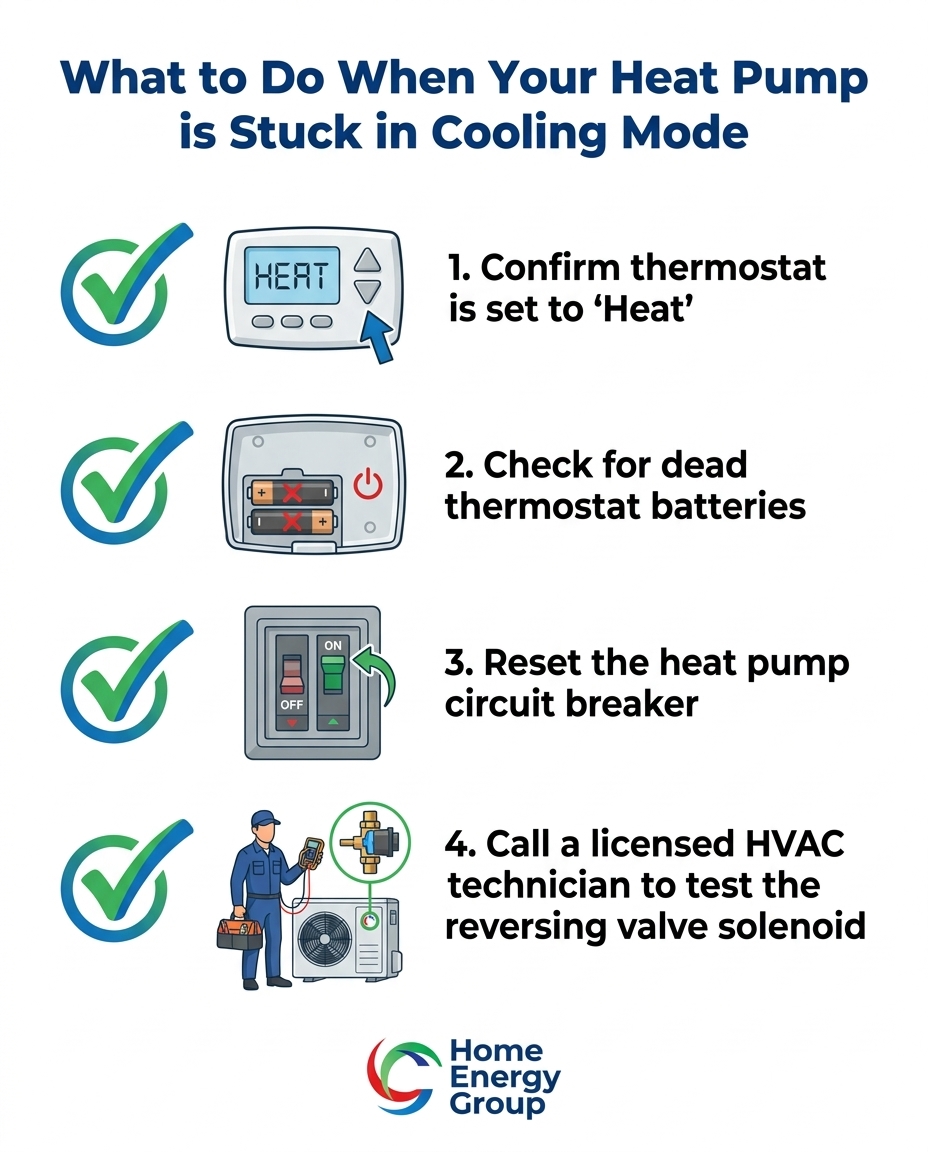
1. Confirm the thermostat settings: Ensure the thermostat is explicitly set to "Heat" and not "Auto" or "Cool." Verify that the temperature setpoint is at least three to five degrees higher than the current room temperature to force the system to kick on.
2. Check and replace thermostat batteries: Even if the screen is on, weak batteries can cause erratic behavior. Swap them out for a fresh set to rule out weak signal transmission to the O/B terminal.
3. Reset the heat pump circuit breaker: Sometimes the logic board in the outdoor unit just needs a hard reboot. Locate the breaker for your heat pump in your electrical panel. Turn it completely off for 30 to 60 seconds, then flip it back on. This drops the voltage to the solenoid and can sometimes allow a sticky valve to relax into the heating position.
4. Inspect your indoor air filter: Severe airflow restrictions can cause a heat pump to behave erratically. If the filter is clogged with dust, the indoor coil can get too cold, potentially triggering a safety switch or an unnecessary defrost cycle that blasts cold air into the home.
Taking a few minutes for testing your system before the September transition fully sets in can save you a lot of morning frustration.
When It Is Time to Call a Licensed HVAC Technician
If you have walked through the preliminary checks—you have fresh batteries, a clean filter, and you have reset the breaker—but the system is still blowing cold air, you have reached the threshold for professional intervention. A reversing valve that refuses to shift is not a DIY repair. Testing and replacing this component involves high-voltage electricity and tapping into the pressurized refrigerant lines, which requires specialized gauges and an EPA certification.
When a Home Energy Group technician arrives, they will perform a methodical diagnostic sequence. First, they will use a multimeter to test the electrical continuity to the reversing valve solenoid. If the solenoid is receiving power but not creating a magnetic field, the technician can often replace just the electrical coil without opening the sealed refrigerant system. If the solenoid is working perfectly, the technician will check the refrigerant pressures to determine if the internal brass slide is mechanically seized. Our team is committed to accurately diagnosing these specific reversing valve issues and educating you on system mechanics. We ensure you understand exactly what the problem is, rather than jumping straight to selling new equipment when a targeted repair will suffice.
However, if your system is older and the mechanical valve itself has failed, the repair involves recovering the refrigerant, cutting out the old valve, brazing in a new one, and recharging the system. Depending on the age and condition of the unit, a major repair might prompt a larger conversation about replacement. For example, one local homeowner recently needed a new heating and cooling system to address their home's changing needs; we provided detailed quotes for compatible systems, and they appreciated the responsiveness and clear understanding of the new system's value. If a replacement is ultimately necessary, keep in mind that general energy rebates or federal tax credits may apply to qualifying high-efficiency heat pump upgrades, helping offset the investment.
If you are stuck without heat and need a professional diagnostic, exploring professional heat pump repair services is the safest next step.
Preventing Fall Transition Failures
The best way to handle a stuck reversing valve is to prevent it from failing in the first place. In our experience maintaining heat pumps across the Pacific Northwest, seasonal preparation is the key to avoiding being caught without heat on that first freezing morning. Routine maintenance allows a technician to catch sticking valves, weak solenoids, and frayed wiring long before you actually need to rely on the heating mode.
A comprehensive fall tune-up involves much more than just changing a filter. Here is what a proactive approach looks like:
• Verifying the O/B terminal configuration: A technician will test the communication between the thermostat and the outdoor unit to ensure the signal is strong and uninterrupted.
• Testing the defrost board operation: The defrost control board dictates when the system temporarily switches modes in the winter. Testing this ensures the system won't get locked in a defrost cycle.
• Checking electrical amp draws: By measuring the electrical pull of the compressor and solenoids, a technician can spot a failing component before it seizes completely.
• Cleaning the coils: Keeping the outdoor and indoor coils clean reduces the overall strain on the compressor and refrigerant cycle during heavy mode-switching seasons.
When you stay ahead of wear and tear, your system runs smoother and lasts longer. And when unexpected replacements are necessary, speed and quality matter—like when we installed a new ductless heat pump system for a local customer in just a couple of hours, leaving them extremely pleased with the rapid turnaround and comfort restoration. Enrolling in a routine HVAC maintenance plan is the most effective way to ensure your system is transitioned safely from summer cooling to winter heating.
Frequently Asked Questions About Heat Pump Mode Issues
Why is my heat pump blowing cold air on heat mode?
It is usually due to a stuck reversing valve, a misconfigured thermostat, or the system temporarily running in defrost mode. If the system has been running in cooling mode all summer, the valve can physically stick when asked to switch to heating. Alternatively, weak thermostat batteries or a disrupted communication wire can prevent the signal from telling the outdoor unit to switch modes. If the cold air only lasts for about ten minutes during freezing weather, your system is likely just running a normal defrost cycle to melt ice off the outdoor coil.
How do you unstick a reversing valve on a heat pump?
While a system reset can clear electronic glitches, physically unsticking a valve requires a licensed technician to diagnose the solenoid and refrigerant pressures safely. You can try turning off the heat pump's circuit breaker for 60 seconds to reboot the logic board and drop voltage to the solenoid. If that does not allow the valve to relax into the correct position, a professional must step in. Do not attempt to hit or tap the brass valve, as this can easily dent the casing and permanently ruin the component.
How do I know if my reversing valve is bad?
Signs include the system refusing to switch modes, a clicking sound at the outdoor unit without a mode change, or refrigerant hissing continuously without the unit heating or cooling effectively. You might also notice that the outdoor unit is running, but the air coming from your indoor vents remains the opposite of what you set on the thermostat. A technician will use a multimeter and refrigerant gauges to confirm if the electrical solenoid has failed or if the internal slide is mechanically jammed.
Can I manually switch my reversing valve?
No. The valve is sealed within the pressurized refrigerant circuit and operates electronically via a solenoid; it cannot be switched manually by a homeowner. There is no external lever or switch on the valve body. Forcing the system to change modes requires electrical testing and a deep understanding of the 24-volt control wiring. Attempting to bypass the system manually poses a severe risk of electrical shock and permanent equipment damage.
Does a stuck reversing valve mean I need a whole new heat pump?
Not necessarily. Often, just the electrical solenoid needs replacing, which is a relatively straightforward and common repair. If the mechanical valve itself is seized, a professional can recover the refrigerant and replace the brass part without replacing the entire system. However, if your heat pump is well over a decade old and uses outdated refrigerant, the labor involved in a mechanical valve replacement might make upgrading to a new, high-efficiency system a more logical long-term investment.
Restore Your Home's Comfort This Fall
A chilly house in the middle of the Brush Prairie WA fall transition doesn't have to stay that way. While a heat pump stuck in cooling mode is inconvenient, understanding the mechanics of your reversing valve helps you make informed decisions about your home's comfort. By performing a few safe preliminary checks—like verifying your thermostat settings and rebooting the breaker—you can rule out simple electronic glitches on your own.
If those steps don't restore your heat, it is time to seek professional diagnostics. You need a definitive go/no-go threshold from a licensed technician who can accurately test the solenoid and refrigerant pressures. Do not let a stubborn valve leave your family shivering. Schedule a professional inspection today to resolve the cooling mode lock and ensure your system is fully prepared to handle the winter weather ahead.