Vetting a Contractor's Warranty Support Before Committing to a New Furnace
The Hidden Risk of Comparing Furnace Quotes on Equipment Alone
If you have multiple estimates sitting on your kitchen table, vetting a contractor's warranty support before committing to a new furnace is the single most critical step you can take to protect your home. At Home Energy Group, we often remind Brush Prairie homeowners that it is easy to focus entirely on the brand name printed on the cabinet, the energy efficiency rating, and how quickly the initial installation can be scheduled. While those details certainly matter, they only represent the first day of your new heating system's lifespan. The critical oversight happens when you fail to ask who will actually answer the phone and perform the work if the unit fails during a mid-winter freeze.
During the September pre-heating season, contractor schedules are relatively open, and everyone is eager to earn your business. However, a true evaluation of a new furnace installation requires looking far beyond the equipment itself. You need to examine the contractor's post-install labor warranty and their emergency response capabilities. Establishing these expectations clearly before you sign a contract prevents highly stressful, out-of-pocket emergency repairs later in the year. When evaluating professional heating services, focusing on the long-term support structure is what separates a reliable investment from a risky transaction.
Understanding the Gap Between Manufacturer Parts and Contractor Labor Warranties
In our years of serving the Brush Prairie area, one of the most common misunderstandings our team encounters in the heating industry is the belief that a "ten-year warranty" covers everything. To protect yourself, you need to understand the specific distinction between the parts warranty provided by the factory and the labor warranty provided by the installing contractor.
Standard manufacturer warranties typically cover replacement parts for five to ten years. However, a parts warranty does not cover the specialized labor required to figure out what went wrong, nor does it cover the physical work of removing the broken component and installing the new one. Labor is usually only covered by the local installing contractor, and this coverage often lasts for just one to two years.
What a Parts Warranty Actually Covers
The manufacturer's guarantee is strictly limited to the physical components of the machine. If a factory defect causes a gas valve to fail, the manufacturer will ship a replacement valve to your contractor. They will not, however, pay for the technician's time to test the system, order the part, or put it in. Furthermore, manufacturers include strict exclusions; if the part failed due to improper installation, the factory warranty is immediately voided.
The True Cost of Unwarranted Labor
Without a strong contractor guarantee backing up your new furnace installation, you can face significant labor costs even on fully "warrantied" equipment. We see it happen all too often: if a breakdown occurs in year three, the factory provides the part for free, but you are still responsible for the diagnostic fees to dispatch a technician, the hourly labor rates for complex part replacements, and any emergency after-hours surcharges.
• Manufacturer Parts Warranty — Typical Duration: 5 to 10 Years — What It Covers: Factory defects, replacement components, internal hardware. — What It Excludes: Diagnostic time, physical labor, shipping fees, maintenance issues.
• Contractor Labor Warranty — Typical Duration: 1 to 2 Years — What It Covers: Technician dispatch, diagnostic testing, physical repair work. — What It Excludes: Failures due to lack of homeowner maintenance, external damage.
Why Emergency Response Capabilities Matter During a Cold Snap
A furnace breakdown is rarely convenient. Heating systems do not typically fail on a mild autumn afternoon; they break down when the system is working its absolute hardest to fight off extreme cold. With the reality of Brush Prairie WA's cold, damp winters, a mid-winter breakdown requires urgent, reliable warranty support to restore heat and protect your home from severe cold-weather damage.
A contractor's labor warranty is only as good as their ability to dispatch a technician promptly when the temperatures drop. Evaluating a company's after-hours response policy is a critical step in the vetting process. Reliable heating is fundamentally a safety issue, not just a comfort issue, especially for vulnerable household members or homes prone to frozen pipes.
Real-world response times make all the difference. Our team at Home Energy Group recently assisted a local homeowner who found themselves in a highly stressful situation during a winter freeze when their radiant ceiling heat and wood stove failed just as her husband was returning home from the hospital after surgery. Recognizing the urgent safety risk, our technicians immediately scheduled an emergency installation of a Daikin heat pump, ensuring the house had reliable heat before he even walked through the door. That is the exact level of urgency your chosen contractor must be capable of delivering.
Evaluating the Contractor Relationship Beyond the Initial Sale
The true test of a furnace installation isn't the day the equipment is carried into your basement; it is how the contractor handles the inevitable adjustments, minor calibrations, or unexpected faults during the first major cold snap. A trustworthy professional provides transparent labor guarantees and demonstrates accountability that extends far beyond the initial equipment sale.
Getting multiple quotes during the September pre-heating season is a smart move, but those quotes should be evaluated on the responsiveness and clarity of the company providing them. A contractor who is communicative, thorough, and patient during the quoting process is significantly more likely to be reliable during a frantic warranty claim in January. Conversely, if a company is difficult to reach when they are trying to earn your business, they will be nearly impossible to reach when they owe you free warranty labor.
Working with a contractor focused on a long-term relationship means you benefit from responsive after-hours service and transparent guarantees. For example, our installation crew recently helped a returning customer who needed both a furnace and a heat pump installed. Because they had already established a relationship with our reliable team, the project was completed precisely within the estimated timeframe with high-quality equipment. A contractor who delivers on their promises initially and stands by their work builds the kind of trust that gives you absolute confidence in your heating system.
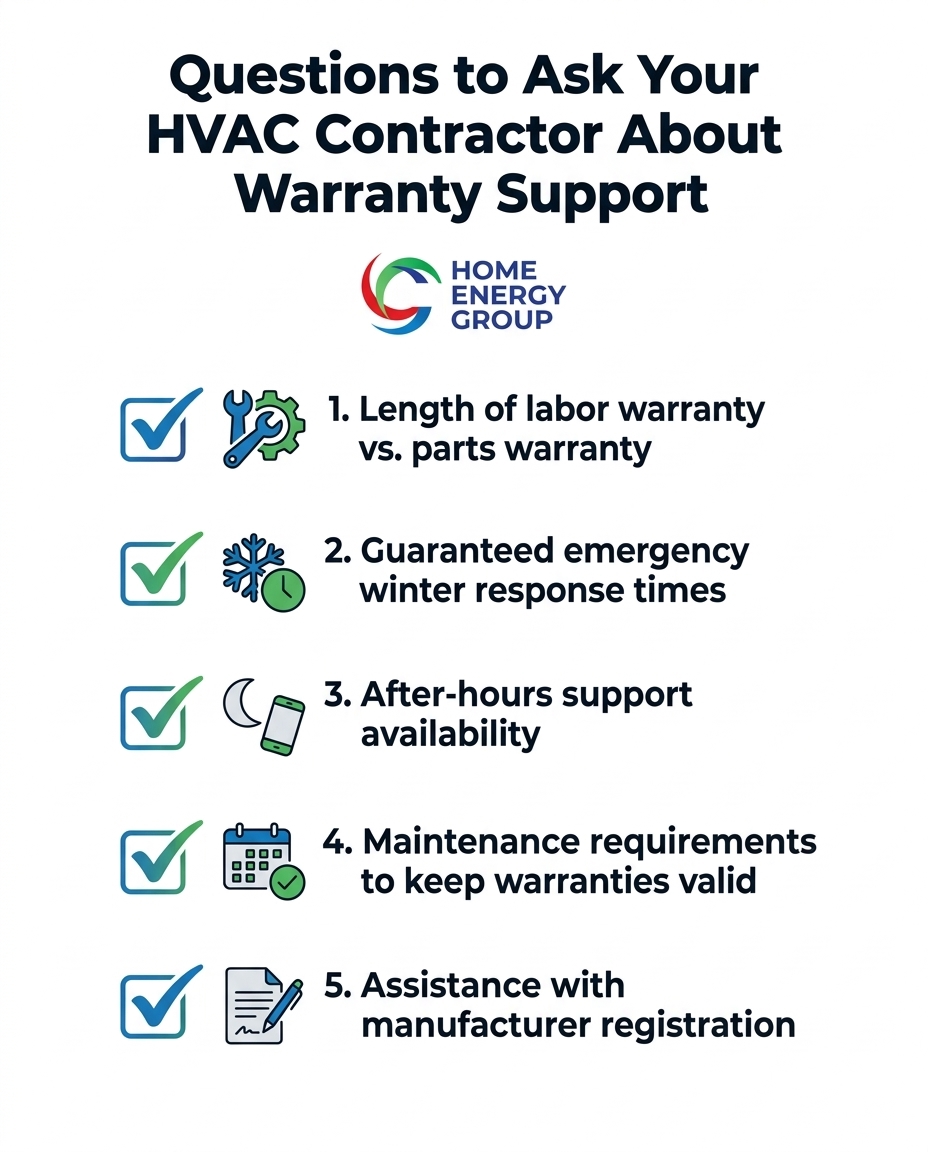
Questions to Ask Your HVAC Contractor About Warranty Support
Before you sign on the dotted line for a new heating system in Brush Prairie WA, you need to ask highly specific questions. Vague promises of "taking care of you" are not enough. When homeowners consult with our Home Energy Group experts, we encourage them to use this checklist to vet a contractor's specific after-hours response policies and labor warranties:
• How long is the labor warranty provided directly by your company? Get the exact timeframe in writing, clearly separated from the manufacturer's parts warranty.
• What is your guaranteed response time for emergency heating failures in the winter? Ask if they prioritize warranty customers when their schedule is completely booked during a freeze.
• Do you have a dedicated after-hours support team? Find out if your midnight call goes to an answering machine, a third-party dispatch center, or an actual on-call technician.
• Are there any actions that will void your labor warranty? Understand exactly what your responsibilities are regarding filter changes and professional upkeep.
• Will you handle the manufacturer parts warranty registration? Failing to register equipment within 60 days often cuts the factory warranty in half. A reputable contractor will file this paperwork on your behalf.
Protecting Your Coverage: The Role of Ongoing Professional Care
Even the most comprehensive warranty on the market is not a free pass to ignore your heating system. Lack of documented annual professional maintenance is the leading cause for manufacturers to void equipment warranties outright. If a blower motor burns out because a clogged filter restricted airflow for two years, the factory will reject the parts claim, categorizing the failure as homeowner neglect.
Contractors also require regular upkeep to honor their labor guarantees. Establishing an ongoing maintenance plan immediately after installation ensures the system operates efficiently and remains fully covered under all agreements. We highly recommend setting this up during the September pre-heating season, getting your new system on a regular autumn schedule before the winter rush begins.
Proactive care identifies minor issues before they become major, warranty-claiming emergencies. A technician performing an annual tune-up can spot a failing sensor, a loose electrical connection, or a slight drop in gas pressure and correct it on the spot. This preventative approach keeps your system running smoothly and ensures that if a major component ever does fail, you have the complete service records required to process your warranty claim without friction.
Navigating Local Compliance and Installation Standards
A warranty is a legal agreement, and it requires the equipment to be installed legally. Manufacturer warranties often stipulate that equipment must be installed according to all local building codes, regional regulations, and factory specifications. An installation that cuts corners puts your entire coverage at risk.
At Home Energy Group, our installation team meticulously handles all necessary paperwork and ensures every installation meets the specific regional standards required in Brush Prairie WA. Unpermitted work or improper installation techniques—such as incorrect gas piping or undersized ductwork transitions—can instantly void both parts and labor warranties. The factory relies on the expertise of the installer; if the installer fails to follow the rules, the factory will not subsidize the resulting breakdowns.
Verifying a contractor's commitment to local compliance is a final, vital step in the vetting process. You can learn more about these specific requirements by understanding the permit requirements for furnace replacement in Washington State. A contractor who eagerly pulls permits and invites third-party inspections is a contractor who stands confidently behind the quality of their work.
Frequently Asked Questions About Furnace Warranties
What is the difference between an HVAC parts and labor warranty?
A parts warranty is provided by the manufacturer and covers the cost of replacement hardware if a factory defect occurs. A labor warranty is provided by the local installing contractor and covers the technician's time, diagnostic fees, and physical work required to replace that broken part. You need both to avoid out-of-pocket costs during a breakdown.
What is a standard labor warranty for HVAC?
A standard labor warranty from an HVAC contractor typically lasts for one to two years after the installation date. While some premium contractors may offer longer labor guarantees, the industry baseline focuses on covering any initial installation adjustments or early-life component failures during the first couple of heating seasons.
Does a new furnace come with a warranty automatically?
Yes, a new furnace automatically comes with a base manufacturer parts warranty out of the box, usually lasting five years. However, to unlock the full ten-year parts warranty, the equipment must be properly registered with the manufacturer within a specific window (usually 60 days) after installation.
What actions will void a furnace warranty?
The most common action that voids a furnace warranty is failing to schedule and document annual professional maintenance. Other actions that void coverage include improper installation, failing to pull local permits, using unapproved aftermarket replacement parts, and severe homeowner neglect, such as running the system with completely blocked air filters.
Are extended HVAC labor warranties worth the investment?
Extended labor warranties can be highly valuable if you plan to stay in your home for many years and want predictable heating costs. Because a single complex repair requiring hours of diagnostic time can be costly, an extended labor agreement acts as an insurance policy, ensuring you won't face surprise repair bills for the duration of the coverage.
How quickly should an HVAC contractor respond to a winter heating emergency?
During a severe winter cold snap, a reliable HVAC contractor should respond to a complete heating failure within 24 hours, and often much sooner for vulnerable households. When vetting contractors during the September pre-heating season, always ask for their specific emergency response times and verify that they have a dedicated after-hours support system.
Secure Your Comfort and Peace of Mind This Season
Choosing the right contractor ensures your home stays warm, safe, and protected, no matter what the Brush Prairie WA winter brings. By prioritizing clear labor warranties, responsive after-hours service, and a commitment to long-term support, you protect your investment long after the installation day is over. Take the time to ask the hard questions and explore professional installation options that stand proudly behind their work. If you are ready to upgrade your home's heating system with a team you can trust, explore our flexible financing options to make your next project a reality.