Diagnosing Mid-Summer Compressor Strain in La Center Homes

Is Your AC Compressor Failing or Just Surviving the Heatwave?
Is your AC actually broken — or just struggling to keep up? At Home Energy Group, our team frequently fields calls from frantic homeowners asking this exact question. Diagnosing mid-summer compressor strain in La Center homes is a common challenge when July peak heat hits with prolonged 90+ degree days. Your air conditioner is running nonstop, yet the house still feels uncomfortably warm. It is easy to assume the worst, but an older system working at maximum capacity acts very differently than one experiencing a mechanical failure. The decision point for many homeowners becomes whether to nurse a struggling unit through the rest of the season or proactively replace it before a total breakdown. Understanding the physical limits of your equipment is the first step toward making an informed, pressure-free decision about your home comfort.
For comprehensive HVAC Services, including targeted Air Conditioning Services, scheduling an objective evaluation helps clarify your next steps.
How Prolonged Heat Stresses Older AC Systems in the Pacific Northwest
When outdoor temperatures spike and stay elevated for days on end, your air conditioner is forced into a relentless cycle of heat extraction. The compressor, often referred to as the heart of the cooling system, bears the brunt of this workload. Its job is to pressurize the refrigerant so it can release absorbed indoor heat to the outside air. However, when the ambient outdoor air is already sweltering, rejecting that heat becomes significantly more difficult, forcing the compressor to work harder and run longer.
The Mechanics of Thermal Degradation
Continuous operation directly increases the internal temperatures of the compressor's motor windings. Under normal conditions, the cool refrigerant returning to the compressor helps dissipate the heat generated by the motor. But during an extreme heatwave, the system runs at a 100% duty cycle, meaning it never shuts off long enough to cool down. This constant thermal stress accelerates the degradation of internal components. The lubricating oils inside the compressor can begin to break down, reducing their effectiveness and increasing mechanical friction. Over time, this friction leads to premature wear on the bearings and valves, turning a minor strain into a major mechanical failure.
The Pacific Northwest Climate Shift
In our years of servicing homes across La Center and Brush Prairie WA, our technicians have seen first-hand how this issue has become particularly pronounced. Older HVAC systems in our area were often not sized or designed for the prolonged 90+ degree July heatwaves that are now common. Many homes are equipped with older 10 to 13 SEER (Seasonal Energy Efficiency Ratio) units. When these systems were installed a decade or more ago, they were perfectly adequate for the region's historically milder summers. Today, those same units lack the cooling capacity to handle modern, sustained heat spikes. They are forced to run continuously just to maintain a baseline level of comfort, pushing aging components past their original design limits.
Visual and Auditory Indicators of AC Compressor Strain
Identifying the difference between a system that is working hard and one that is actively failing requires careful observation. Fortunately, there are several safe, non-invasive ways to monitor your outdoor condenser unit. If you notice any of the following symptoms during July peak heat with prolonged 90+ degree days, your system is likely experiencing severe mechanical strain.
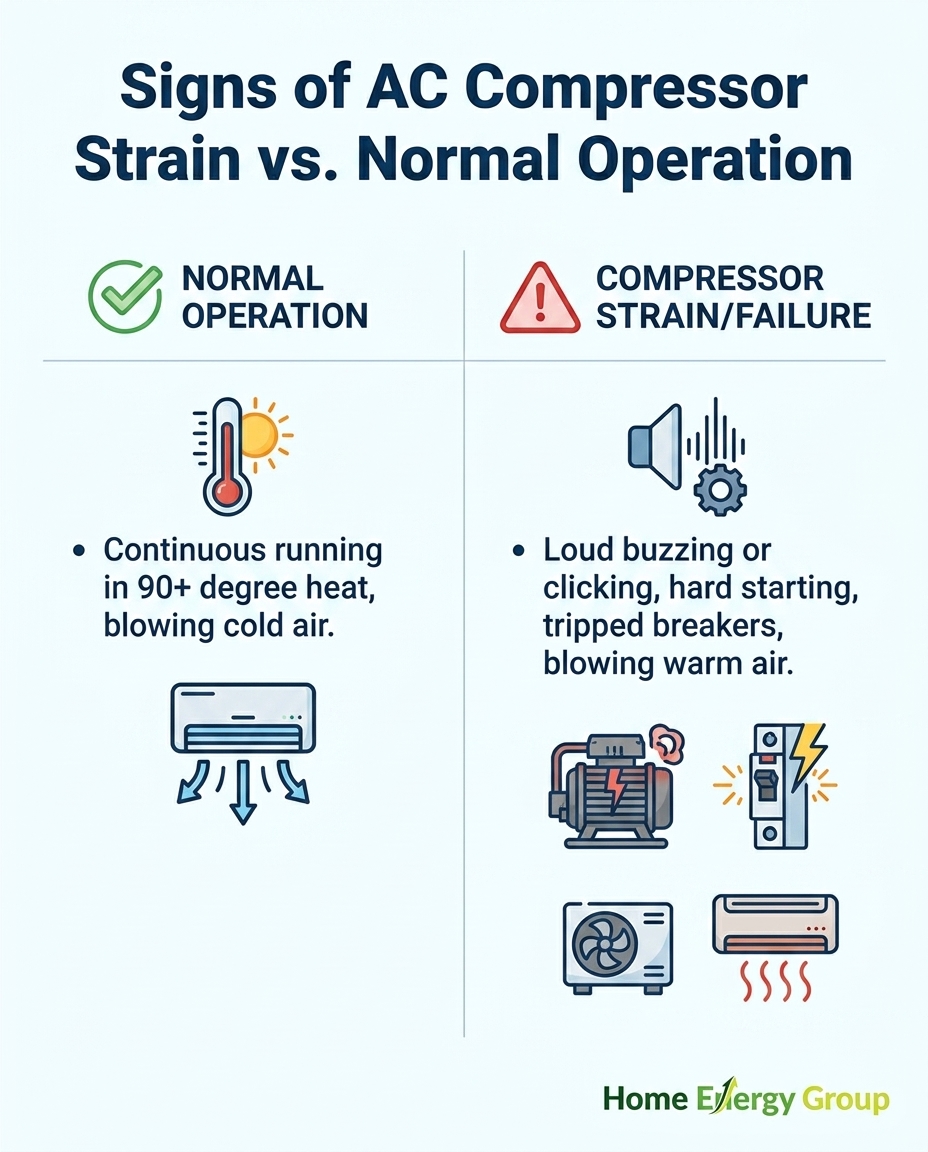
• Loud buzzing or clicking: A distinct buzzing sound from the outdoor unit often points to a failing capacitor or a compressor that is receiving electrical current but cannot physically start. Clicking sounds usually indicate a struggling relay switch.
• Hard starting: If the outdoor unit shudders violently, dims the lights in your house, or hesitates for several seconds before the fan finally spins up, the compressor is experiencing a "hard start." This means it requires an abnormal surge of electricity to overcome internal mechanical resistance.
• Tripped circuit breakers: A compressor that is overheating or suffering from electrical shorts will pull more amperage than the circuit can handle. If your AC breaker trips, it is a built-in safety mechanism doing its job. Resetting it repeatedly can cause catastrophic electrical damage.
• Grinding or metal-on-metal noises: These harsh auditory cues typically mean the internal bearings are failing or the motor mounts have broken, allowing internal components to scrape against each other.
• Warm air blowing indoors: If the indoor fan is running constantly but the air coming from your vents is tepid or warm, the compressor may have stopped pumping refrigerant entirely, even if the outdoor fan is still spinning.
A critical safety warning: Never attempt DIY electrical testing on a live HVAC unit, and never attempt to handle or top off refrigerant yourself. Modern AC systems utilize high-voltage electricity and pressurized chemicals that require specialized training and EPA certification to handle safely. Always leave internal diagnostics to a licensed professional.
Normal Operation vs. Mechanical Failure: What Homeowners Need to Know
One of the most common sources of anxiety during a heatwave is a thermostat that never seems to reach its set point. If you set your thermostat to 72°F but the indoor temperature hovers at 76°F late in the afternoon, it is natural to worry that the system is broken. However, running continuously during the hottest part of the day is often completely normal for older units in La Center and Brush Prairie WA. Air conditioners are sized to maintain a specific temperature differential between indoors and outdoors (usually about 20 degrees). When it is 100°F outside, an older system running flawlessly will still struggle to pull the indoor temperature below 78°F.
Understanding the 100% Duty Cycle
A system operating at maximum capacity will run long, continuous cycles. As long as the air coming out of the vents is noticeably colder than the air returning to the system, the compressor is doing its job. The prolonged cycle time is simply the system's response to an overwhelming heat load. This continuous operation does increase wear and tear, but it does not immediately indicate a mechanical failure. In fact, long cycles are better for humidity control and overall efficiency than rapid on-and-off cycling.
The Danger of Short-Cycling
Contrast normal long cycles with "short-cycling," a condition where the compressor turns on, runs for only a few minutes, and abruptly shuts off, only to restart moments later. Short-cycling is a massive red flag. It forces the compressor to endure the most stressful part of its operation—the startup phase—repeatedly. This rapid cycling draws excessive electricity, overheats the motor windings, and drastically reduces the lifespan of the equipment. Short-cycling can be caused by an oversized unit, severe airflow restrictions, or low refrigerant levels, all of which require professional intervention.
Thermal Overload Shutdowns
When our team responds to urgent calls from local homeowners or property managers during a summer heatwave, troubleshooting these situations quickly reveals whether the system is simply running continuously to combat the heat or if a component has failed, requiring a technician to restore comfort. In severe cases of strain, a compressor will experience a thermal overload shutdown. Modern compressors have an internal sensor that detects when the motor temperature exceeds safe operating limits. To prevent catastrophic melting of the internal wiring, the sensor cuts power to the compressor while allowing the indoor fan to keep running. If your outdoor unit goes completely silent while the indoor fan blows warm air, the compressor may be in thermal lockout. It will not restart until it has cooled down completely, which can take several hours.
Should You Nurse Your Dying Compressor Through Summer or Replace It?
When an older compressor is strained by 90+ degree days, the right next step is evaluating the risks of keeping it alive versus upgrading the system. The average lifespan of a residential AC compressor is typically 10 to 15 years. If your unit is approaching or has surpassed this milestone, the mechanical wear has already significantly reduced its efficiency. Deciding whether to repair or replace requires an objective look at your specific situation.
Our team at Home Energy Group believes in an honest, transparent assessment approach that provides a pressure-free framework for evaluating these risks. Rather than defaulting to an immediate sales pitch, our technicians conduct a thorough evaluation of the overall health of the system to help you make a logical choice. You might consider Replacing the AC Condenser if the indoor components are still relatively new, though matching system compatibility is critical.
• Nursing the Old Unit — Pros: Delays a major installation project; buys time to plan for an upgrade in the off-season. — Cons & Risks: High risk of sudden, complete breakdown during the hottest weeks of August; higher monthly energy bills; compounding stress on the indoor blower motor.
• Targeted Repair (e.g., Capacitor) — Pros: Restores function quickly if the compressor itself is still mechanically sound. — Cons & Risks: Does not reverse internal mechanical wear; other aging components remain at risk of sequential failure.
• Proactive Replacement — Pros: Guaranteed reliable cooling; significantly improved energy efficiency; warranty protection against future failures. — Cons & Risks: Requires scheduling an installation project; involves a larger upfront commitment.
Proactive Steps to Reduce Thermal Stress on Your AC
If your system is working overtime to keep your La Center and Brush Prairie WA home comfortable, there are several actionable, safe steps you can take to ease the burden on the compressor. Reducing the system's workload directly translates to lower internal operating temperatures and less mechanical friction.
1. Clear the perimeter of the outdoor unit: The condenser needs a massive volume of unobstructed airflow to reject heat effectively. Remove tall grass, weeds, overhanging branches, and stored outdoor furniture from a two-foot radius around the unit. Restricted airflow forces the fan motor and compressor to work exponentially harder.
2. Gently rinse the exterior condenser coils: Over the course of a year, dirt, pollen, and cottonwood fluff form an insulating blanket over the aluminum fins of the outdoor coil. This trapped dirt holds heat in. First, turn off the power to the unit at the outdoor disconnect box. Then, use a garden hose on a gentle shower setting to rinse the debris outward. Never use a pressure washer, as the high velocity will flatten the delicate aluminum fins and destroy the unit's ability to breathe.
3. Manage your indoor heat load: The less heat that enters your home, the less heat the AC has to remove. Keep blinds and heavy curtains closed on south and west-facing windows during peak sun hours. Avoid running heat-generating appliances like ovens, dryers, and dishwashers until the late evening when outdoor temperatures have dropped.
4. Change the indoor air filter: A clogged air filter chokes the indoor blower motor, slowing down the volume of cold air distributed through the house. This forces the outdoor compressor to run longer cycles to achieve the same cooling effect. Check the filter monthly during peak summer usage.
5. Schedule professional optimization: As HVAC professionals, we strongly recommend routine maintenance to ensure the system is evaluated before peak temperatures arrive. Timely and professional servicing addresses minor airflow restrictions, calibrates electrical draws, and verifies refrigerant charges before they escalate into major compressor strain. Investing in Routine AC Maintenance is the most effective way to optimize performance and reduce mechanical friction long-term.
Frequently Asked Questions About AC Repair in La Center
When the heat hits, having quick, reliable answers is essential. Below are common questions homeowners ask when seeking ac repair la center, focusing on distinguishing normal operation from serious mechanical trouble. If you reside in the La Center Service Area, understanding these symptoms can help you act quickly when it matters most.
How do I know if my AC compressor is going bad?
Look for signs like hard starting, tripped breakers, and loud buzzing or grinding noises. If the outdoor unit shakes violently when turning on, or if you hear a metallic screeching sound, the internal bearings are likely failing. Additionally, if the unit runs constantly but only blows warm air, the compressor may have stopped pumping refrigerant entirely.
Why is my AC compressor struggling in the heat?
High ambient temperatures force the compressor to work harder to reject heat, increasing internal temperatures and mechanical wear. When the outdoor air is over 90 degrees, transferring the heat absorbed from your home into the outside environment requires significantly more pressure. This sustained effort pushes aging components to their absolute limits.
Is it normal for my AC to run all day in 90 degree weather?
Yes, older units may run continuously to maintain temperature, but they should still be blowing cold air, not short-cycling. As long as the air coming out of your vents is cool and the indoor temperature is holding steady or slowly dropping, a long, continuous cycle is a normal response to an extreme heat load.
Should I repair or replace my AC compressor?
This depends heavily on the unit's age and the severity of the mechanical failure. An AC unit over 10 to 15 years old usually warrants replacement, as a new compressor placed into an aging system is likely to fail again due to other worn components. For newer systems still under warranty, replacing just the failed compressor is often the logical choice. Federal tax credits may apply to qualifying heat pump or energy-efficient installations, so it is worth checking current incentives when considering a replacement.
When should I call for professional AC repair in La Center?
Call immediately if the unit trips the breaker, makes loud metal-on-metal noises, or blows completely warm air. Continuing to run a system that exhibits these severe symptoms can cause electrical damage to other parts of your home and turn a potentially repairable issue into a mandatory full-system replacement.
Can a dirty condenser coil cause compressor failure?
Yes, dirt traps heat, forcing the compressor to run hotter and longer, which can eventually lead to thermal overload. When the aluminum fins are clogged with mud, pollen, or debris, the system cannot exhaust heat efficiently, causing internal pressures and temperatures to spike to dangerous levels.
Get an Honest Assessment of Your AC System Today
Knowing whether your older AC is safe to run or on the verge of failure is critical when navigating July peak heat with prolonged 90+ degree days in La Center and Brush Prairie WA. Guessing at the health of your compressor only leads to unnecessary stress and potentially sudden breakdowns during the hottest week of the year. Scheduling an objective inspection allows you to understand your options without enduring high-pressure sales tactics. By securing clear, safe-to-observe indicators of compressor strain and a logical framework for your next steps, you can confidently decide whether to nurse your current unit through the summer or upgrade to a more reliable system.