What Warrants a 2AM Emergency Call Versus a Next-Morning HVAC Appointment
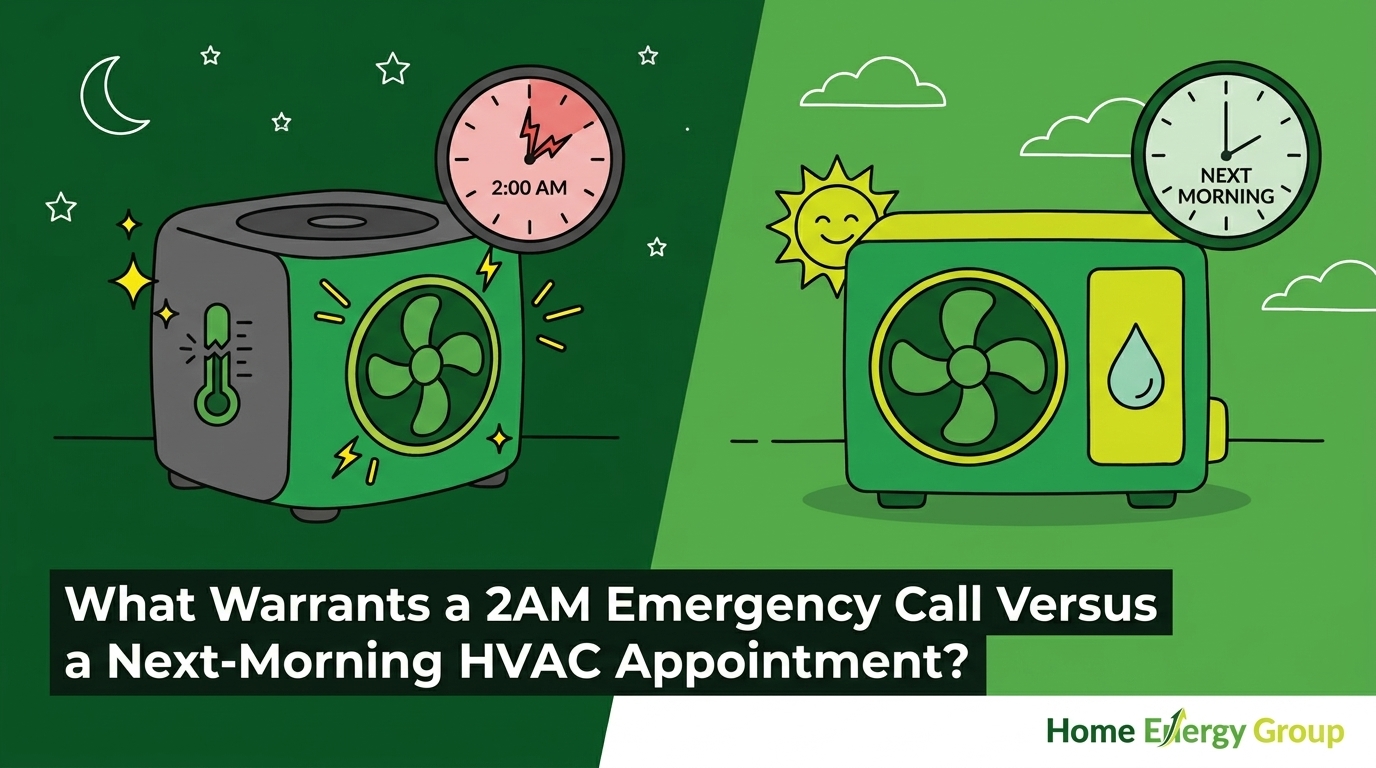
Is Your Midnight AC Failure a True Emergency?
If your system stops blowing cold air at 10 PM during an August late-summer heatwave, you are immediately faced with a stressful decision: exactly What Warrants a 2AM Emergency Call Versus a Next-Morning HVAC Appointment? It is incredibly frustrating to wake up sweating in a rapidly warming house, staring at a thermostat that refuses to budge. Your first instinct might be to grab your phone and call the nearest 24-hour dispatch line to get a technician out immediately.
However, not every overnight cooling failure requires an immediate response. The core decision comes down to determining if the situation poses a genuine health, safety, or property risk, or if it is simply an uncomfortable inconvenience. Many late-night system breakdowns can safely wait until 8 AM, allowing you to avoid unnecessary after-hours premiums while still getting your home back to a comfortable temperature the very next day.
Before you make that late-night call, it helps to understand how to triage your system's symptoms. By evaluating your indoor temperature, the presence of vulnerable family members, and any unusual signs coming from your equipment, you can make an informed choice. If you need professional help assessing the situation, exploring our air conditioning services can provide a baseline for what standard repairs typically involve.
Criteria for a 2AM Emergency Call: Health and Safety Risks
While an uncomfortable night of sleep is frustrating, an actual HVAC emergency is defined by immediate threats to health and safety. Indoor temperatures can rise dangerously fast if outdoor temperatures do not drop overnight. In Brush Prairie WA, evenings usually cool down nicely, allowing homes to vent trapped heat. However, during late summer "heat domes," solar heat remains trapped inside, and an overnight AC failure can quickly escalate into a true safety risk.
The World Health Organization (WHO) strongly recommends keeping indoor temperatures below 90 degrees for healthy adults. Once a home exceeds this threshold, the body struggles to regulate its internal temperature, increasing the risk of heat exhaustion and dehydration. If your indoor thermometer is creeping toward 90 degrees and the outdoor air offers no relief, that situation justifies waking up an emergency technician.
Carbon monoxide alarms sounding during a heating cycle represent an absolute, non-negotiable emergency. If your detectors go off, you must evacuate the home immediately and call emergency services, followed by a professional to inspect the system. Never ignore these alarms, as carbon monoxide is colorless, odorless, and highly dangerous.
Protecting Vulnerable Family Members
The presence of vulnerable residents automatically lowers the threshold for what constitutes an emergency. Infants, the elderly, and individuals with underlying medical conditions cannot regulate their body temperatures as effectively as healthy adults. For these groups, a rapidly warming or freezing house is not just a nuisance; it directly impacts their physical recovery and overall health.
One local homeowner faced a situation where a family member was recovering from surgery and required a stable, warm indoor temperature urgently. A technician was dispatched for an emergency visit to install a new heat pump, ensuring the home was safely heated before the patient even arrived from the hospital. If your household includes someone who is medically fragile, do not hesitate to call for priority service. If you suspect your heating system is failing before it completely breaks down, scheduling furnace troubleshooting during standard hours can prevent these midnight crises entirely.
Active Property Damage and Electrical Hazards
Beyond human health, mechanical and structural warning signs require immediate intervention to prevent catastrophic damage or even a house fire. Your HVAC system uses a significant amount of electricity, and when components fail catastrophically, they can create severe hazards that cannot wait until sunrise.
Electrical burning smells are a massive red flag. Often described as resembling a "fishy" odor or melting plastic, these smells indicate that wires, capacitors, or blower motors are actively overheating. According to U.S. Fire Administration data, ignoring electrical warning signs in major home appliances is a leading cause of preventable residential fires. If you smell melting plastic near your vents or the indoor air handler, you have a 2AM emergency on your hands.
Active water leaks also demand immediate attention. If your indoor air handler is located in an attic or a second-story closet, a clogged condensate drain line can send gallons of water pouring through your ceiling. If a leak cannot be contained with a bucket and is actively damaging drywall, flooring, or structural framing, you need professional help right away.
Identifying Dangerous Electrical Odors
It is helpful to know the difference between normal operational smells and dangerous electrical odors. Follow these steps if you suspect an electrical issue:
1. Identify the scent: A brief, dusty smell when a system turns on for the first time in months is normal. A persistent, acrid smell of burning rubber or plastic is not.
2. Listen for accompanying noises: Electrical issues are often accompanied by loud buzzing, humming, or continuous clicking from the equipment.
3. Cut the power immediately: If you smell burning plastic, go directly to your electrical panel and flip the circuit breaker for your HVAC system to the "Off" position.
4. Evacuate if necessary: If you see smoke or the smell intensifies after cutting the power, evacuate the home and call the fire department.
When It Is Perfectly Safe to Wait for a Next-Morning Appointment
If your system is simply blowing warm air, making a mild rattling noise, or failing to turn on—but no vulnerable residents are at risk and no burning smells are present—it is perfectly safe to wait until morning. Mechanical failures are highly inconvenient, but they do not inherently require a midnight dispatch.
Waiting for standard business hours actually provides several distinct advantages. First, you avoid the after-hours premium associated with emergency dispatch. A trustworthy, transparent contractor actively wants to help you avoid these fees when your safety is not compromised. Second, local HVAC supply houses are closed at 2 AM. If your system requires a specialized proprietary part, an emergency technician might only be able to apply a temporary patch overnight, meaning they will still have to return the next day to finish the job.
For example, when managing rental properties with urgent tenant needs, property managers often face frantic late-night calls. In many cases, technicians can contact the tenants immediately to troubleshoot over the phone. This helps determine if an issue can wait until morning or if a technician must be dispatched within an hour to prevent severe discomfort. Often, a simple reset or filter change resolves the panic, proving that not every sudden stop requires a midnight visit. If your system is running constantly but failing to cool, you might be curious about what happens if your AC runs continuously while you wait for the morning appointment.
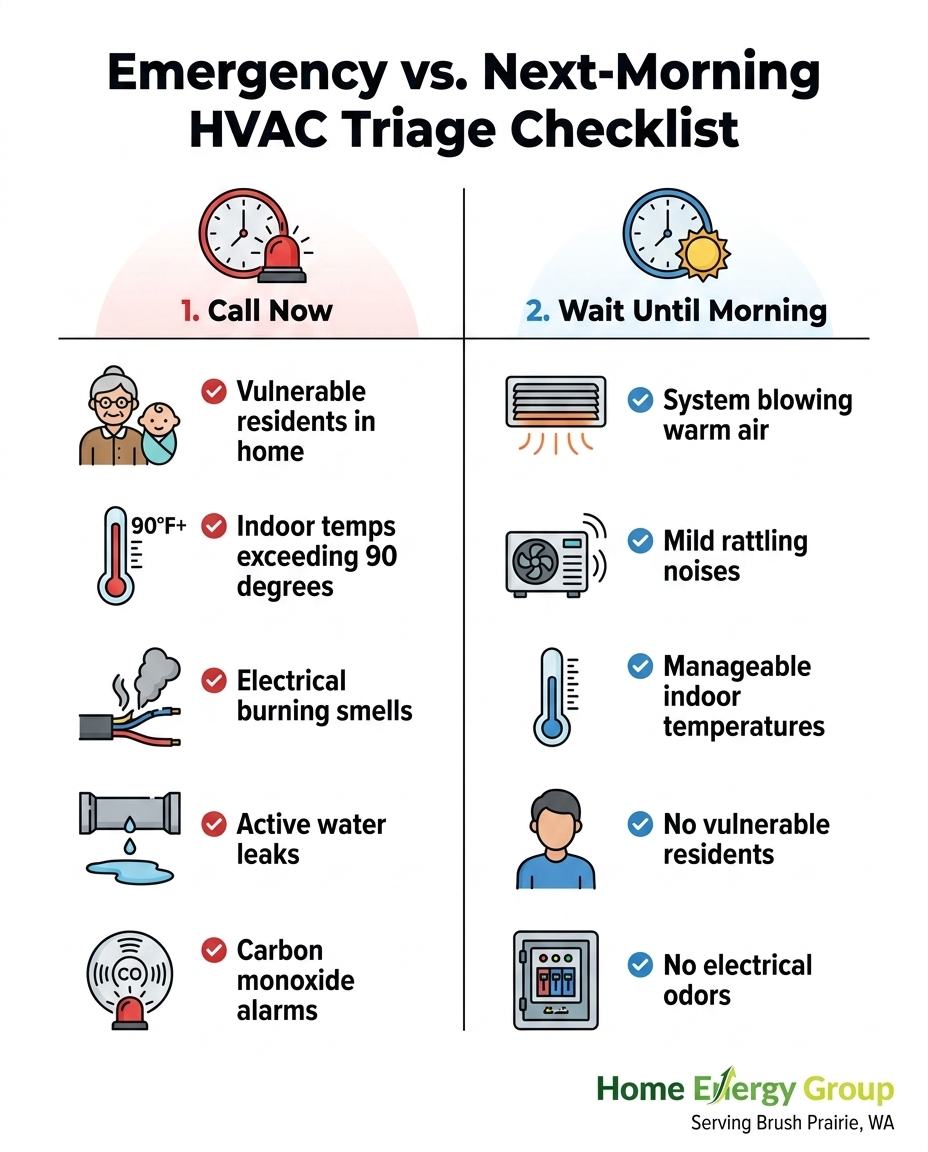
Emergency vs. Next-Morning Triage Checklist
To make your late-night decision easier, use this straightforward comparison to evaluate your current situation in Brush Prairie WA:
• Indoor Temperature — Call Now (2AM Emergency): Approaching or exceeding 90°F with no outdoor relief. — Wait Until Morning (8AM Appointment): Uncomfortable but manageable (e.g., 80°F).
• Household Members — Call Now (2AM Emergency): Infants, elderly, or medically fragile individuals present. — Wait Until Morning (8AM Appointment): Healthy adults and older children who can tolerate warmth.
• System Odors — Call Now (2AM Emergency): Strong smell of melting plastic, burning wire, or "fishy" electrical scent. — Wait Until Morning (8AM Appointment): Musty smell or no unusual odors at all.
• Water Issues — Call Now (2AM Emergency): Active, uncontainable leak damaging ceilings or drywall. — Wait Until Morning (8AM Appointment): Small drip that can be easily caught in a bucket overnight.
• System Noises — Call Now (2AM Emergency): Loud, aggressive electrical buzzing or screaming metal-on-metal. — Wait Until Morning (8AM Appointment): Mild rattling, squeaking, or simply silence (won't turn on).
How to Safely Shut Down Your System and Manage Overnight Comfort
Once you have determined that your August late-summer heatwave breakdown can wait until standard business hours, you need to secure the equipment and manage your family's comfort for the rest of the night. Do not attempt any DIY repairs involving the electrical components or refrigerant lines, as this can cause further damage or void your warranty.
Instead, follow these practical steps to safely shut down the malfunctioning unit and keep the house as cool as possible until the technician arrives:
• Turn the thermostat to the "Off" position: If the system is struggling and blowing warm air, leaving it running will only strain the compressor and waste electricity. Turn it completely off to prevent further mechanical damage.
• Check the circuit breaker once: Go to your electrical panel and see if the breaker for the AC has tripped. You can attempt to reset it exactly one time. If it trips again immediately, leave it alone. Repeatedly resetting a tripping breaker can cause an electrical fire or permanently destroy the compressor.
• Create strategic cross-ventilation: If the outdoor nighttime air is cooler than the trapped indoor air, open windows on opposite sides of the house. Place a box fan pointing inward on the cooler side of the house, and another fan pointing outward on the warmer side to push the hot air out.
• Maximize localized airflow: Utilize ceiling fans in occupied bedrooms. Remember that fans cool people, not rooms, by creating a wind-chill effect on your skin. Make sure the ceiling fans are set to rotate counterclockwise to push air straight down.
Year-Round Triage: Evaluating Heat Pump and Heating Failures
While an August breakdown focuses on extreme heat, this same decision-making framework applies to heating emergencies during the colder months. Local temperature swings mean winter nights can easily drop below freezing, turning a broken heating system into an urgent situation for both your property and your health.
If a heat pump fails during freezing temperatures, you face immediate risks of frozen pipes bursting and severe cold exposure for your family. The same rules apply: assess the vulnerability of the residents and the extremity of the outdoor temperatures. If the house is rapidly dropping into the 40s and you have no secondary heat source like a gas fireplace or space heaters, that constitutes a genuine emergency.
Emergency services are available 24/7 for both heating and cooling crises when genuine safety risks exist. Whether you are dealing with a frozen coil in the summer or a failed reversing valve in the winter, knowing when to call for heat pump repair immediately versus waiting for sunrise ensures your home stays safe without causing unnecessary panic.
Schedule Your Repair with an Honest, Local Team
Understanding what warrants a 2AM emergency call empowers you to make safe, cost-effective decisions for your home. By evaluating indoor temperatures, checking for electrical hazards, and prioritizing the needs of vulnerable family members, you can confidently decide whether to pick up the phone immediately or set up some fans and wait for morning.
Whether you are facing a midnight crisis in Brush Prairie WA or simply need a next-morning fix, expert technicians are ready to restore your home's comfort. You deserve an honest partner who will give you transparent advice and high-quality service. When you are ready to get your system back on track, reach out to book your priority appointment for heating repair services or AC troubleshooting today.
Frequently Asked Questions
What is considered an HVAC emergency?
An HVAC emergency is any situation that poses an immediate risk to health, safety, or property. This includes indoor temperatures reaching dangerous extremes (above 90 degrees or below freezing), the presence of vulnerable residents like infants or the elderly, active electrical burning smells, or sounding carbon monoxide alarms. If none of these factors are present, the issue can usually wait for standard business hours.
Is a broken AC an emergency?
A broken AC is only an emergency if the outdoor temperatures are dangerously high and the indoor heat cannot be managed, or if the system is causing secondary damage. If the unit is leaking water through your ceiling or emitting the smell of melting plastic, it requires immediate attention. Otherwise, a unit that simply blows warm air is an inconvenience rather than a 2AM emergency.
Can I wait until morning for AC repair?
Yes, in the vast majority of cases, you can safely wait until morning for AC repair. If your family is healthy, the indoor temperature is uncomfortable but tolerable, and there are no signs of electrical fires or severe leaks, waiting saves you from paying after-hours emergency dispatch fees. Just be sure to turn the thermostat to "Off" to prevent further strain on the equipment.
Should I turn off my AC if it's broken?
Absolutely. If your AC is blowing warm air, making aggressive grinding noises, or rapidly turning on and off (short cycling), you should turn the thermostat to the "Off" position immediately. Allowing a broken system to continue running can turn a minor, inexpensive repair into a catastrophic compressor failure, costing you significantly more in the long run.
What should I do if my HVAC system smells like burning plastic?
If your HVAC system smells like burning plastic, you must immediately cut power to the unit at your main electrical breaker panel. This odor usually indicates melting wire insulation or an overheating motor, which is a serious fire hazard. Do not turn the system back on; call an emergency HVAC technician right away, and if you see smoke, evacuate and call the fire department.
How can I keep my house cool overnight without AC?
To keep your house cool overnight without a working AC, create cross-ventilation by opening windows on opposite sides of the home. Place exhaust fans in upper-level windows to push hot air out, and pull cooler nighttime air in through lower-level windows. Use ceiling fans in occupied bedrooms to create a cooling breeze, and avoid using heat-generating appliances like ovens or dryers.